
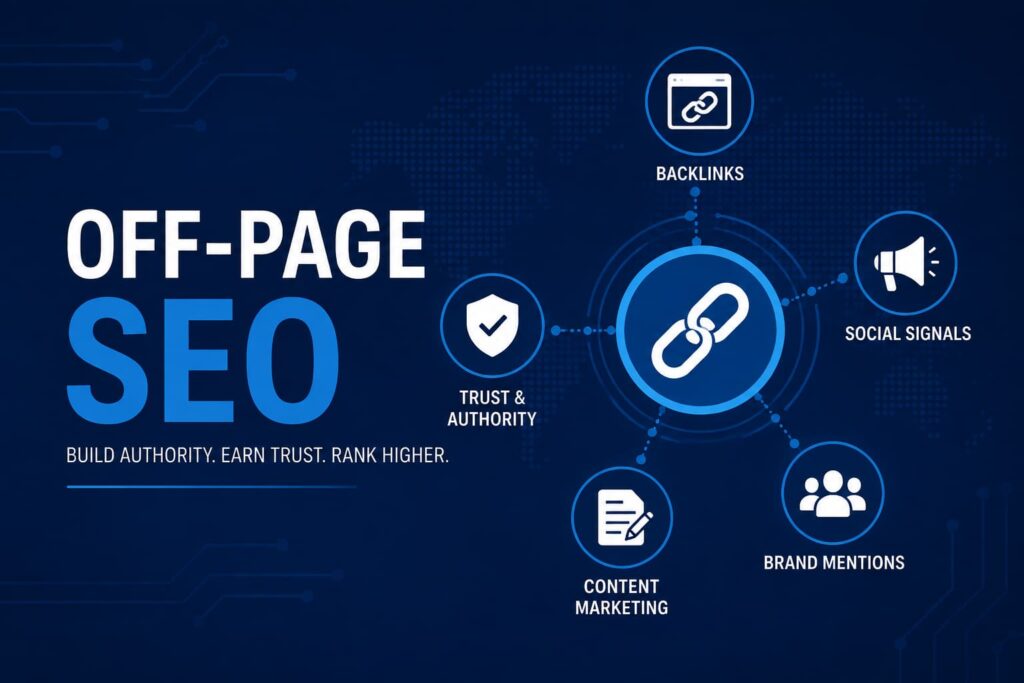

Off-page SEO is an important part of search engine optimization that focuses on activities outside your website to improve its authority, credibility, and search engine rankings. While on-page SEO helps optimize your website content and technical elements, off-page SEO helps search engines understand how trustworthy and valuable your website is compared with competitors.
A strong off-page SEO strategy can help you earn high-quality backlinks, increase brand visibility, attract referral traffic, and build a stronger online reputation.
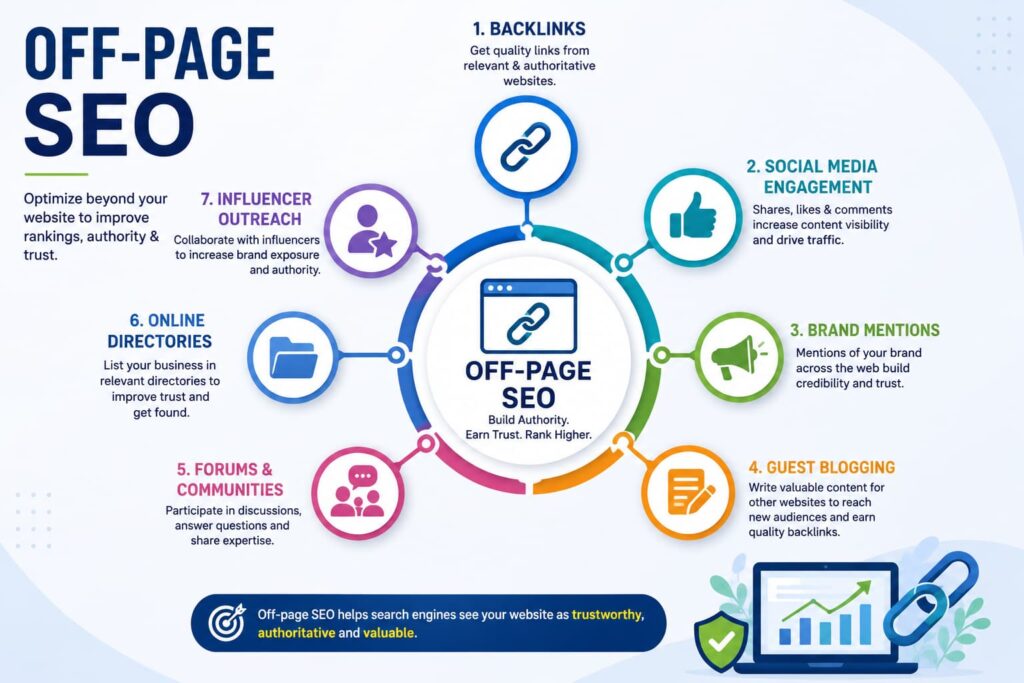
What Is Off-Page SEO?
Off-page SEO refers to actions taken outside your website to improve its visibility and authority in search engine results. The most common off-page SEO activity is link building, where other websites link to your pages.
However, off-page SEO is not limited to backlinks. It can also include brand mentions, digital PR, guest posting, influencer collaborations, social media promotion, and other activities that help establish your website as a trusted source.
Why Is Off-Page SEO Important?
Search engines consider many signals when determining which websites deserve to rank higher. When reputable websites mention or link to your content, it can indicate that your website provides useful and trustworthy information.
The benefits of off-page SEO include:
- Building website authority
- Earning high-quality backlinks
- Improving search engine visibility
- Increasing referral traffic
- Growing brand awareness
- Building online credibility
- Supporting long-term SEO growth
Best Off-Page SEO Strategies
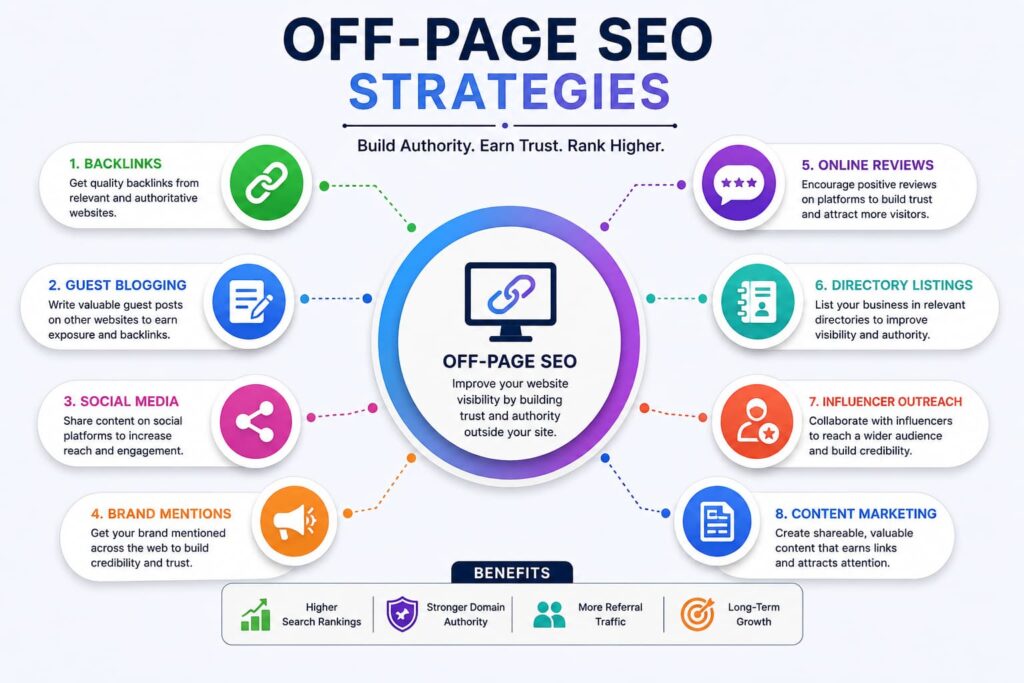
1. Build High-Quality Backlinks
Backlinks are links from other websites to your website. However, not every backlink has the same value. A link from a relevant and trustworthy website is generally more valuable than a large number of low-quality links.
Focus on earning backlinks naturally by creating useful content that other websites want to reference.
2. Create Link-Worthy Content
One of the best ways to earn backlinks is to publish valuable content.
You can create:
- Detailed guides
- Original research
- Case studies
- Infographics
- Statistics and reports
- How-to articles
- Industry resources
When your content provides useful information, other websites may link to it as a reference.
3. Guest Posting
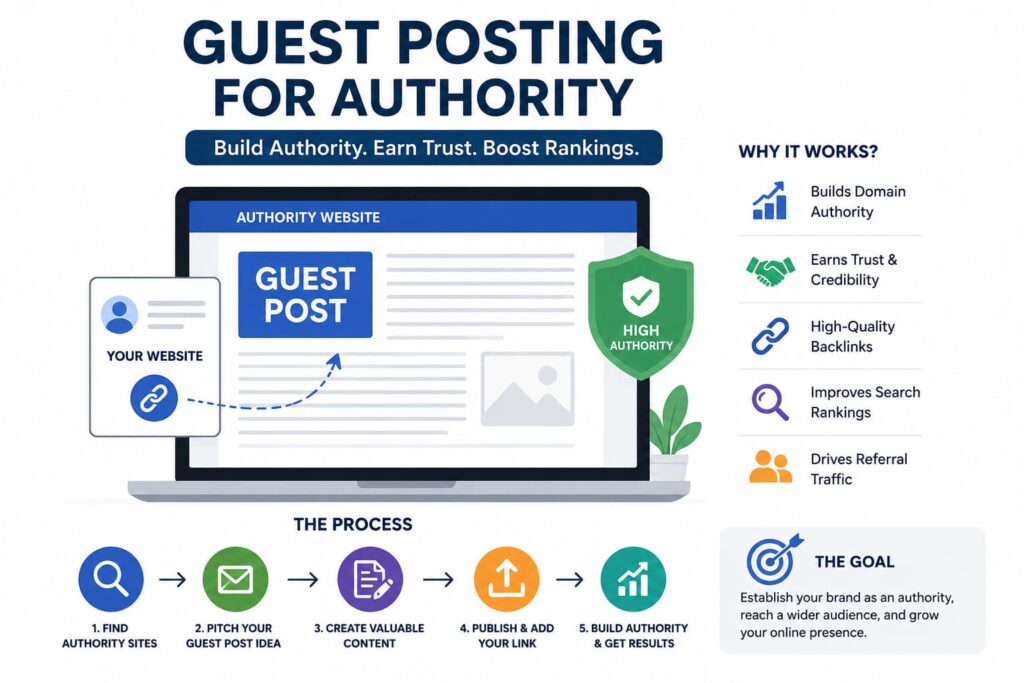
Guest posting involves writing useful articles for relevant websites and including a natural link to your own website when appropriate.
The goal should not be to publish on as many websites as possible. Instead, focus on websites that are relevant to your industry and have a genuine audience.
4. Digital PR
Digital PR can help your brand earn attention from online publications, bloggers, journalists, and industry websites.
You can promote:
- New research
- Original studies
- Company announcements
- Expert opinions
- Interesting industry data
- Useful resources
Digital PR can generate both brand awareness and valuable website mentions.
5. Broken Link Building
Broken link building is another useful off-page SEO technique. It involves finding broken links on relevant websites and suggesting your own useful content as a replacement.
For example, if a website contains a broken link to an outdated SEO guide and you have a high-quality SEO guide on your website, you can contact the website owner and suggest your resource.
6. Competitor Backlink Research
Analyzing your competitors’ backlinks can help you discover potential link-building opportunities.
Look for websites that link to your competitors and determine whether they may also be interested in your content.
Instead of copying your competitors’ strategy exactly, use their backlink profiles to identify relevant opportunities.
7. Promote Your Content on Social Media
Social media links may not work the same way as traditional editorial backlinks, but social media can help increase content visibility.
When more people discover your content, there is a greater opportunity for bloggers, journalists, businesses, and other website owners to find and reference it.
8. Build Brand Mentions
Not every off-page SEO benefit comes from a clickable backlink. Brand mentions across websites, publications, communities, and other online platforms can help increase your visibility and reputation.
Monitor where your brand is being discussed and look for opportunities to build relationships with relevant websites and communities.
9. Participate in Relevant Online Communities
You can build visibility by contributing genuinely useful information to relevant communities, forums, professional networks, and industry discussions.
Avoid excessive self-promotion or posting links simply to obtain backlinks. Focus on answering questions and providing useful information.
10. Collaborate With Industry Experts
Interviews, expert roundups, podcasts, webinars, and collaborations can help you connect with other professionals in your industry.
These activities can increase brand exposure and may lead to mentions, referrals, and links from relevant websites.
Off-Page SEO vs. On-Page SEO
| On-Page SEO | Off-Page SEO |
|---|---|
| Optimizes elements on your website | Focuses on activities outside your website |
| Improves content and page structure | Builds authority and reputation |
| Includes keywords and headings | Includes backlinks and brand mentions |
| Includes internal linking | Includes external link building |
| Focuses on website relevance | Focuses on credibility and authority |
Both approaches are important. A website with excellent content but no authority may struggle to compete, while a website with many backlinks but poor content may also perform poorly.
How to Build a Strong Off-Page SEO Strategy
A successful off-page SEO strategy should focus on quality rather than quantity.
Start by creating valuable content that deserves to be shared. Then identify relevant websites, publications, and industry communities where your content can provide genuine value.
A simple process is:
Create valuable content → Promote it → Build relationships → Earn mentions and backlinks → Monitor results → Improve your strategy
Avoid shortcuts such as buying large numbers of low-quality backlinks, participating in link schemes, or using spammy directories. These tactics can damage your website’s reputation and SEO performance.
How to Measure Off-Page SEO
You can monitor your off-page SEO efforts by tracking metrics such as:
- Number of referring domains
- Quality and relevance of backlinks
- Organic search traffic
- Referral traffic
- Brand mentions
- Keyword rankings
- Domain authority metrics from SEO tools
- Growth in website visibility
Remember that SEO results usually take time. Instead of focusing only on the number of backlinks, evaluate whether your links are relevant, trustworthy, and helping your website attract the right audience.
Final Thoughts
Off-page SEO plays a major role in building website authority, improving online visibility, and earning valuable backlinks. The most effective approach is to create useful content, build genuine relationships, earn relevant backlinks, and establish your brand as a trusted source in your industry.
Rather than chasing hundreds of backlinks, focus on earning high-quality links from relevant and trustworthy websites. Combined with strong on-page and technical SEO, a well-planned off-page SEO strategy can support sustainable growth in search engine rankings.
Common Off-Page SEO Mistakes to Avoid
While working on off-page SEO, it is important to focus on ethical and sustainable strategies. Some shortcuts may provide quick results, but they can negatively affect your website in the long run.
1. Buying Low-Quality Backlinks
Buying large numbers of backlinks from unrelated or low-quality websites is not a good SEO practice. Search engines can identify manipulative link-building patterns, and such links may harm your website rather than improve its rankings.
Focus on earning relevant backlinks through valuable content and genuine relationships.
2. Focusing Only on the Number of Backlinks
Having thousands of backlinks does not necessarily mean having a strong backlink profile. One relevant link from a trusted website can be more valuable than many low-quality links.
Always consider relevance, quality, and context when evaluating backlinks.
3. Using Excessive Exact-Match Anchor Text
Anchor text is the clickable text used in a hyperlink. Using the exact same keyword repeatedly can make your link profile look unnatural.
Instead, use a natural mixture of branded, descriptive, generic, and keyword-related anchor text.
4. Getting Links From Irrelevant Websites
A backlink from a website that has nothing to do with your industry may provide little value. Try to earn links from websites that are relevant to your niche, audience, or topic.
5. Ignoring Content Quality
Link building becomes much easier when you have something valuable to share. If your website contains thin, outdated, or unhelpful content, other websites are less likely to reference it.
Before starting an outreach campaign, make sure your content provides genuine value.
Off-Page SEO for New Websites
Building authority can be challenging when your website is new because it may not have an established reputation or many backlinks.
Start with simple and sustainable activities:
- Create useful, original content.
- Set up professional social profiles.
- Connect with people in your industry.
- Submit your business to relevant and legitimate directories.
- Promote useful resources.
- Start guest posting on relevant websites.
- Build relationships with bloggers and industry professionals.
- Monitor your backlinks regularly.
The goal is to gradually establish your website as a reliable source rather than trying to gain hundreds of backlinks immediately.
How Long Does Off-Page SEO Take to Show Results?
Off-page SEO is a long-term process. The time required to see noticeable results depends on factors such as your website’s age, competition, content quality, backlink profile, industry, and overall SEO strategy.
Some improvements may appear within a few months, while competitive keywords can require significantly more time.
Consistency is more important than expecting immediate results. Continue creating useful content, earning relevant backlinks, and building your website’s reputation.
Off-Page SEO Checklist
Use this checklist when planning your off-page SEO campaign:
- Create valuable and original content
- Research relevant websites in your industry
- Build high-quality backlinks
- Promote useful content
- Try relevant guest-posting opportunities
- Monitor brand mentions
- Analyze competitor backlinks
- Build relationships with industry professionals
- Participate in relevant communities
- Monitor referring domains
- Review your backlink profile regularly
- Remove or address harmful links when appropriate
- Avoid spammy link-building techniques
Advanced Off-Page SEO Strategies
Once you have established the basics of off-page SEO, you can use more advanced techniques to strengthen your website’s authority and attract better-quality backlinks.
1. Resource Page Link Building
Many websites publish resource pages that contain links to useful tools, guides, articles, and industry resources. If you have high-quality content that genuinely adds value, you can contact the website owner and suggest your resource.
For example, if you have written a detailed guide about SEO tools, you could look for websites that maintain SEO resource pages and suggest your guide where relevant.
The key is relevance. Your content should genuinely fit the resource page rather than being submitted simply to obtain a backlink.
2. Skyscraper Technique
The skyscraper technique involves finding popular content in your industry, creating something more useful or comprehensive, and promoting it to websites that may be interested in linking to your improved resource.
For example, you might find an article titled “50 SEO Tips for Beginners.” You could create a more detailed guide containing updated information, examples, visuals, and practical steps.
After publishing your improved resource, identify websites that have linked to similar content and introduce your resource to them.
3. Unlinked Brand Mentions
Sometimes websites mention your business or brand without linking to your website. These are called unlinked brand mentions.
You can monitor these mentions and contact the website owner when appropriate, politely asking whether they would consider adding a relevant link to your website.
This can be an effective way to turn existing brand awareness into useful referral opportunities.
4. HARO-Style Expert Opportunities
Journalists and publishers often look for expert opinions for articles and publications. Responding to relevant journalist requests can help you gain exposure and potentially earn mentions or backlinks.
When responding to these opportunities, provide useful and specific information rather than sending generic promotional messages.
Your expertise should be the main focus.
5. Podcast Link Building
Appearing as a guest on relevant podcasts can help you reach a new audience and establish yourself as an expert.
Podcast opportunities may also result in an author or guest profile containing a link to your website.
Choose podcasts that are relevant to your industry and audience rather than accepting every available opportunity.
6. Interviews and Expert Roundups
Participating in interviews and expert roundups is another way to increase your online visibility.
For example, a digital marketing website might publish an article featuring opinions from several SEO professionals. Providing a useful and original response can help you build relationships while increasing your brand exposure.
7. Original Research and Statistics
Original research is one of the strongest types of content for attracting natural backlinks.
You could conduct:
- Customer surveys
- Industry research
- Market analysis
- Case studies
- Original experiments
- Data comparisons
Other websites may reference your findings when creating their own articles. This can generate organic backlinks over time.
How to Find Off-Page SEO Opportunities
Finding the right opportunities is an important part of your off-page SEO campaign.
Start by researching websites in your industry. Look for blogs, news websites, online publications, resource pages, professional communities, and businesses that publish content related to your niche.
You can also analyze competitor backlink profiles to discover websites that have already linked to similar businesses.
Create a simple spreadsheet containing:
| Website | Topic | Contact | Opportunity | Status |
|---|---|---|---|---|
| Website A | SEO | Guest post | Contacted | |
| Website B | Marketing | Contact form | Resource link | Pending |
| Website C | Digital marketing | Expert quote | Completed |
Keeping track of your outreach prevents you from contacting the same website repeatedly and helps you measure your progress.
Creating an Effective Link-Building Outreach Email
Your outreach message should be short, personalized, and focused on value.
Avoid sending the same generic message to hundreds of websites. Instead, mention a specific article or resource from the website and explain why your content could be useful to its readers.
A good outreach email should include:
- A clear subject line
- A personalized introduction
- A reference to the recipient’s content
- A brief explanation of your resource
- A clear but polite request
- A professional closing
The goal is to build a relationship, not simply ask for a backlink.
How to Evaluate a Backlink
Before pursuing a backlink opportunity, consider several factors.
Relevance
Is the website related to your industry or topic?
Authority
Does the website appear trustworthy and established?
Editorial Value
Would the link provide genuine value to readers?
Traffic
Does the website have an actual audience that could potentially visit your website?
Link Context
Is the link naturally placed within useful content?
A backlink that satisfies these factors is generally more valuable than a random link from an unrelated website.
Building a Natural Backlink Profile
A healthy backlink profile should develop naturally over time. Your links should come from different relevant sources rather than from one type of website.
For example, your backlink profile might include links from:
- Industry blogs
- Online publications
- Business websites
- Educational resources
- Industry associations
- Relevant directories
- Interviews
- Guest articles
- Digital PR campaigns
Avoid trying to manipulate your backlink profile by generating large numbers of links within a short period.
The Role of Relationships in Off-Page SEO
Successful off-page SEO is not only about links. It is also about relationships.
Building relationships with bloggers, journalists, business owners, marketers, influencers, and other professionals can create opportunities for collaborations, interviews, guest contributions, mentions, and referrals.
Instead of thinking about link building as simply “getting links,” think of it as building connections that naturally lead to visibility and authority.
Final Off-Page SEO Strategy
A strong off-page SEO campaign can follow this simple framework:
Step 1: Create valuable content
Publish original, useful, and informative content that deserves attention.
Step 2: Identify relevant websites
Find websites, publications, blogs, and communities that are connected to your industry.
Step 3: Build relationships
Interact with industry professionals and contribute useful information.
Step 4: Promote your content
Share your resources through appropriate channels and outreach.
Step 5: Earn quality backlinks
Focus on relevant and trustworthy websites rather than large quantities of links.
Step 6: Monitor your results
Track backlinks, referring domains, referral traffic, brand mentions, and organic visibility.
Step 7: Improve continuously
Analyze what works and focus more effort on the strategies that generate meaningful results.
Key Takeaway
The foundation of successful off-page SEO is trust. Search engines and users are more likely to value websites that demonstrate expertise, credibility, and genuine authority.
Instead of focusing only on getting backlinks, build valuable content and strong relationships. When your website consistently provides useful information, high-quality backlinks and brand mentions can become a natural result of your overall digital marketing strategy.
Frequently Asked Questions About Off-Page SEO
What is off-page SEO?
Off-page SEO is the process of improving a website’s authority and visibility through activities performed outside the website. Link building, digital PR, brand mentions, and relationship building are common examples.
Are backlinks important for off-page SEO?
Yes. Backlinks remain an important part of off-page SEO. However, quality and relevance are more important than simply obtaining a large number of links.
What is the best off-page SEO strategy?
There is no single strategy that works for every website. Creating link-worthy content, earning relevant backlinks, digital PR, guest posting, and building genuine industry relationships can all contribute to a strong off-page SEO strategy.
Can social media improve off-page SEO?
Social media can help increase content visibility, brand awareness, and referral traffic. While social shares are not the same as traditional backlinks, greater visibility can create opportunities for other websites to discover and link to your content.
Should I buy backlinks?
It is better to avoid buying backlinks intended to manipulate search rankings. Focus instead on earning links through useful content, outreach, digital PR, partnerships, and other legitimate strategies.
Conclusion
Off-page SEO is an essential part of a complete SEO strategy. It helps websites establish authority, earn valuable backlinks, increase brand visibility, and build credibility within their industry.
The best results come from focusing on quality rather than quantity. Create content worth referencing, connect with relevant websites and professionals, promote your resources, and earn backlinks naturally.
Remember, successful off-page SEO is not about collecting as many links as possible. It is about building a strong online reputation that search engines and users can trust.
When combined with effective on-page SEO and technical SEO, off-page SEO can help your website build long-term organic visibility and attract more relevant visitors.