
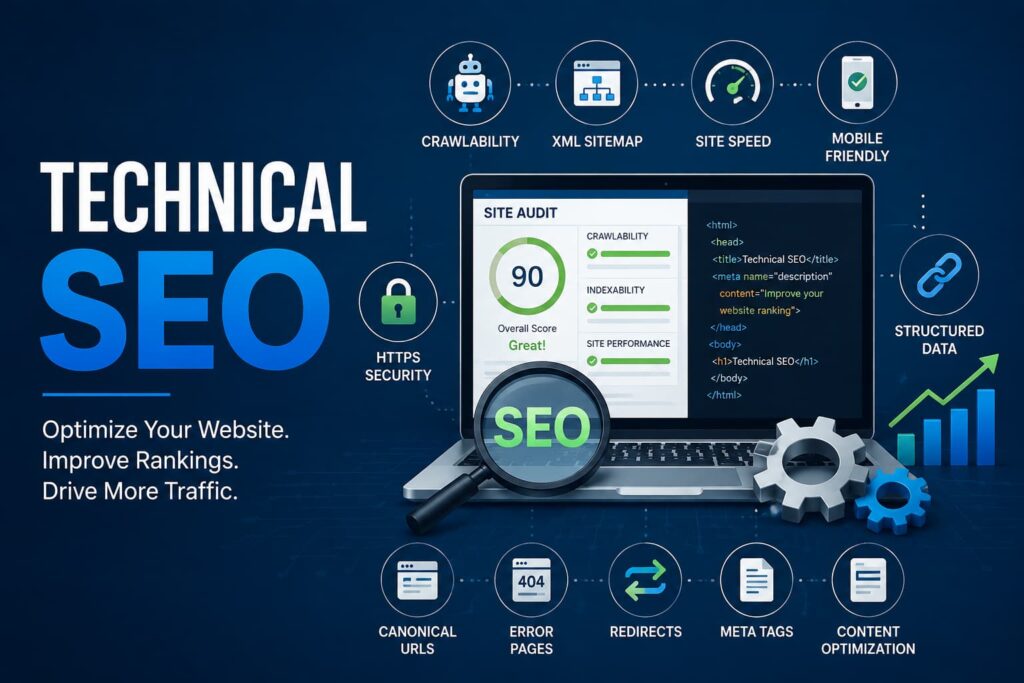

Technical SEO has become one of the most important pillars of search engine optimization in 2026. Creating high-quality content is no longer enough if search engines cannot crawl, understand, or index your website efficiently. Google’s algorithms continue to evolve, placing greater emphasis on website performance, user experience, structured data, mobile usability, and secure browsing. Recent industry data shows that only 42% of websites currently pass all three Core Web Vitals, highlighting that technical optimization remains a major competitive advantage. Median load times among Google’s top-ranking pages are around 1.65 seconds, and nearly 96% of top-ranking pages use HTTPS.
This complete guide explains everything you need to know about Technical SEO in 2026. Whether you’re a beginner learning SEO or an experienced marketer performing technical audits, this guide covers the latest best practices, tools, strategies, and optimization techniques to improve your website’s visibility in Google Search. Instead of chasing algorithm updates, you’ll learn how to build a technically sound website that search engines and users both love.
What Is Technical SEO?
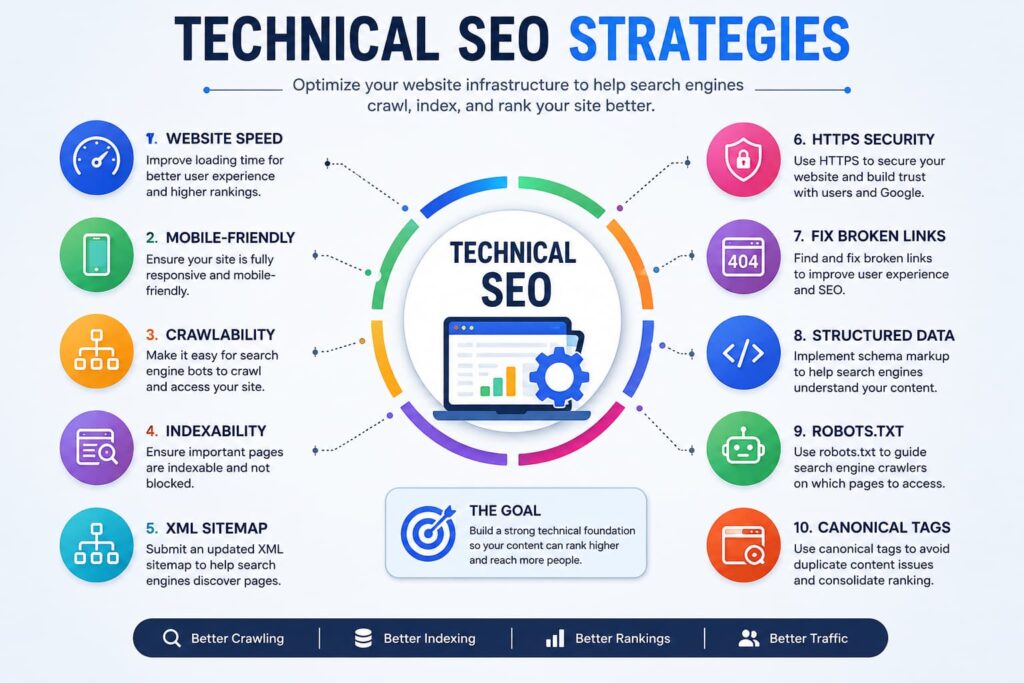
Technical SEO refers to optimizing the technical aspects of a website so search engines can crawl, render, index, and rank pages efficiently. Unlike content optimization or link building, technical SEO focuses on improving your site’s infrastructure. It ensures that every page is accessible, loads quickly, works flawlessly on mobile devices, and provides clear signals about content hierarchy and relevance.
Think of your website as a modern library. Your content represents the books, while technical SEO is the organization system that helps visitors and librarians find every book quickly. Even if your library contains outstanding books, poor organization makes them nearly impossible to discover. The same principle applies to websites. Without proper technical optimization, valuable content may never reach its target audience because search engines struggle to understand or access it.
Technical SEO has expanded significantly over the past few years. Today it includes optimizing Core Web Vitals, mobile-first indexing, structured data, Technical SEO rXML sitemaps, robots directives, canonicalization, JavaScript rendering, crawl budget management, and website architecture. Since Google’s mobile-first indexing is now fully implemented across all websites, every business must prioritize technical performance on mobile devices.
(Continue writing…)
Continue writing please
Why Technical SEO Matters in 2026
Search engines have become far more intelligent than they were just a few years ago. Google no longer evaluates websites solely based on keywords and backlinks. Instead, it measures how efficiently a website performs, how quickly users can interact with it, and whether search engine crawlers can easily understand its content. This shift means Technical SEO has moved from being an optional optimization to an essential ranking factor. A technically optimized website creates a strong foundation that supports every other SEO effort, including content marketing, keyword optimization, and link building. Even the best-written article may struggle to rank if technical issues prevent Google from crawling or indexing it properly.
Another reason technical SEO is so important is the growing influence of AI-powered search experiences such as Google AI Overviews and conversational search engines. These systems rely on well-structured websites that provide clear context through schema markup, organized internal linking, descriptive metadata, and logical page hierarchies. Websites that maintain clean technical architecture are easier for AI systems to interpret, increasing the likelihood of appearing in featured snippets, knowledge panels, and AI-generated summaries. This gives businesses an advantage over competitors that focus only on publishing content without maintaining their site’s technical health.
User experience is another major reason to invest in technical SEO. Visitors expect websites to load almost instantly, work perfectly on smartphones, and provide secure browsing experiences. If pages take several seconds to load or display broken layouts on mobile devices, users often leave before interacting with the content. High bounce rates and low engagement send negative quality signals that can indirectly affect search performance. Technical improvements such as image optimization, browser caching, code minification, and faster server response times contribute to a smoother browsing experience while improving important performance metrics like Largest Contentful Paint (LCP), Interaction to Next Paint (INP), and Cumulative Layout Shift (CLS). These metrics are now central to Google’s evaluation of page quality.
Perhaps the greatest benefit of technical SEO is scalability. As websites grow from dozens of pages to hundreds or even thousands, technical organization becomes increasingly important. Proper URL structures, XML sitemaps, canonical tags, internal linking strategies, and crawl management ensure that search engines can continue discovering and indexing new pages efficiently. Businesses that consistently perform technical audits often identify hidden issues such as redirect chains, duplicate content, orphan pages, and crawl errors before they significantly impact rankings. In a competitive digital landscape where every ranking position matters, maintaining strong technical SEO can provide long-term stability and sustainable organic growth.
Technical SEO vs On-Page SEO vs Off-Page SEO
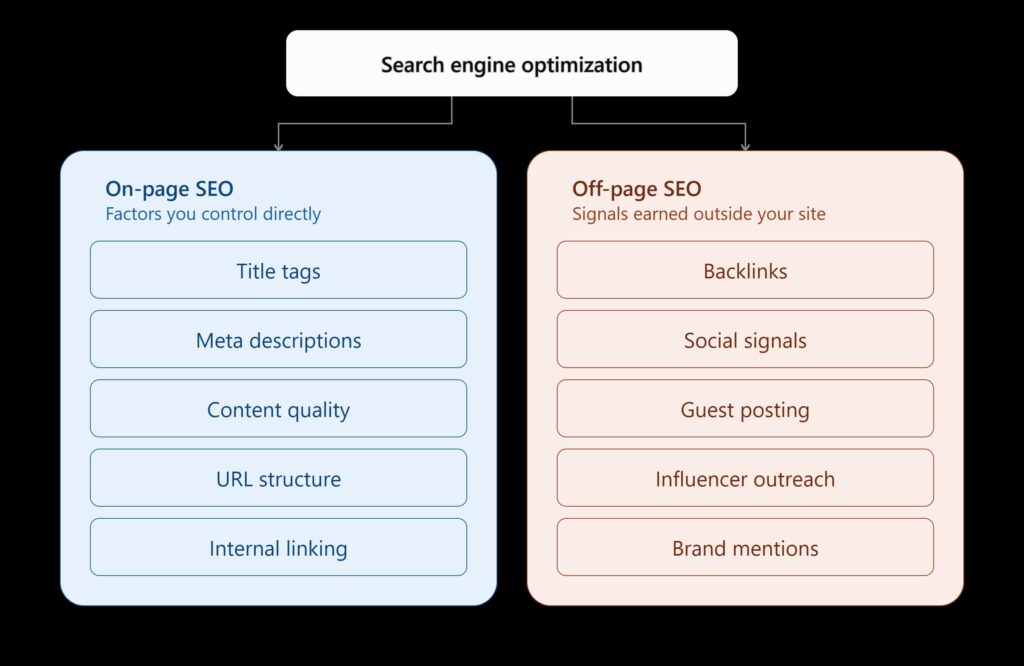
Although all three branches of SEO work together to improve search visibility, they each focus on different aspects of website optimization. Understanding their differences helps create a balanced SEO strategy that delivers consistent results.
| SEO Type | Primary Focus | Examples |
|---|---|---|
| Technical SEO | Website infrastructure | Site speed, XML sitemaps, robots.txt, schema markup, HTTPS, crawlability |
| On-Page SEO | Content optimization | Keywords, headings, meta titles, internal links, image alt text |
| Off-Page SEO | Website authority | Backlinks, brand mentions, digital PR, guest posting, social signals |
Technical SEO forms the foundation of the entire SEO ecosystem. Imagine building a skyscraper. Technical SEO is the foundation and steel framework that supports the entire structure. On-page SEO represents the interior design, ensuring each room is functional, attractive, and easy to navigate. Off-page SEO acts like the building’s reputation, attracting visitors through recommendations and positive reviews. If the foundation is weak, no amount of decoration or advertising will keep the building standing for long. Likewise, a technically flawed website can struggle to rank regardless of how strong its content or backlink profile may be.
On-page SEO focuses on helping search engines understand the meaning and relevance of individual pages. This includes naturally placing the technical SEO keyword in titles, headings, meta descriptions, introductory paragraphs, image alt attributes, and throughout the content. It also involves creating engaging, original content that satisfies user intent while maintaining readability. Internal linking between related articles further strengthens topical authority and improves navigation for both users and crawlers.
Off-page SEO, by contrast, emphasizes building trust and authority beyond the website itself. High-quality backlinks from reputable websites signal credibility to search engines, while digital PR campaigns, social media mentions, influencer collaborations, and brand citations help increase online visibility. However, even the strongest backlink profile cannot compensate for severe technical issues such as blocked pages, indexing errors, or poor site performance. That’s why successful SEO strategies always begin with a solid technical foundation before expanding into content creation and authority building.
When these three SEO disciplines work together, they create a powerful system that improves search rankings, enhances user experience, and drives sustainable organic traffic. Businesses that neglect any one of these areas often leave valuable ranking opportunities untapped. By prioritizing technical excellence first, then optimizing content and earning authority, websites can compete more effectively in Google’s increasingly sophisticated search ecosystem.
(To be continued with: “How Search Engines Crawl and Index Websites” including “Crawling Explained” and “Indexing Explained.”)
Continue writing please
How Search Engines Crawl and Index Websites
Understanding how search engines discover and store your content is the foundation of successful technical SEO. Before a webpage can appear in Google Search, it must first be found, analyzed, rendered, and added to Google’s index. This process may sound simple, but it involves sophisticated systems that evaluate millions of pages every day. If any part of this process fails, your content may never appear in search results, regardless of its quality.
Think of Google as a massive digital librarian. Every day, it sends automated programs called crawlers to explore the internet, following links from one page to another. These crawlers collect information, understand relationships between pages, analyze page quality, and determine whether content deserves a place in Google’s searchable database. Technical SEO ensures this entire journey happens smoothly. A well-optimized website removes obstacles that prevent crawlers from accessing important pages while guiding them toward the content that matters most.
Modern websites often contain thousands of URLs, dynamic content, JavaScript frameworks, videos, images, and interactive elements. Search engines must process all of these efficiently. Poor technical implementation can confuse crawlers, waste crawl budget, or even prevent pages from being indexed altogether. That’s why understanding crawling and indexing is essential for website owners, SEO professionals, and developers alike.
Crawling Explained
Crawling is the first stage of Google’s discovery process. Googlebot, Google’s web crawler, continuously scans the web by following links from one webpage to another. It begins with known URLs and then discovers additional pages through internal links, external backlinks, XML sitemaps, and URL submissions. Every time Googlebot visits your website, it checks for new pages, updated content, deleted URLs, and changes to your site’s structure.
Efficient crawling depends heavily on your website’s architecture. Pages buried deep within complicated navigation structures are harder for crawlers to find. Ideally, important pages should be reachable within three or four clicks from the homepage. A clear internal linking structure not only improves user navigation but also helps distribute link equity throughout your site. Breadcrumb navigation, category pages, contextual internal links, and HTML sitemaps all contribute to better crawlability.
Your robots.txt file also plays an important role during crawling. This file tells search engine crawlers which parts of your website they are allowed or not allowed to access. While robots.txt helps manage crawl behavior, it should be configured carefully. Accidentally blocking important directories can prevent Google from accessing valuable content, CSS files, JavaScript resources, or images needed to render your pages correctly. Regularly reviewing robots.txt after website updates is considered a technical SEO best practice.
Another important concept is crawl budget, which refers to the number of pages Google is willing to crawl on your website during a given period. Large websites with thousands of pages must manage crawl budget efficiently by removing duplicate pages, fixing redirect chains, eliminating broken links, and preventing unnecessary parameter URLs from being crawled. Optimizing crawl budget ensures Google spends more time discovering valuable content instead of wasting resources on low-value or duplicate pages.
Indexing Explained
Once Google successfully crawls a webpage, it decides whether that page deserves to be added to its search index. Indexing is the process of storing and organizing webpage information so it can appear in search results when users perform relevant searches. Being crawled does not automatically mean a page will be indexed. Google evaluates content quality, uniqueness, relevance, page experience, canonical signals, and technical health before making that decision.
One of the most common indexing problems occurs because of duplicate content. If multiple pages contain nearly identical information, Google may choose only one version to index while ignoring the others. This is where canonical tags become essential. A canonical tag tells search engines which version of a page should be treated as the primary version, consolidating ranking signals and preventing duplicate content issues. Proper canonical implementation is a fundamental part of technical SEO, especially for eCommerce websites with product variations and filtered category pages.
Another factor influencing indexing is page quality. Thin content, automatically generated pages, orphan pages with no internal links, or pages blocked by noindex directives may never enter Google’s index. Website owners should regularly monitor Google Search Console’s Pages report to identify URLs that are discovered but not indexed. This report provides valuable insights into indexing issues, allowing site owners to improve content quality, strengthen internal linking, or resolve technical errors that prevent indexing.
Website performance also influences indexing efficiency. Slow-loading pages, server errors, unstable hosting environments, and frequent downtime make it more difficult for Googlebot to access and process your content. Fast, secure, mobile-friendly websites with strong Core Web Vitals provide better crawling and indexing experiences. Combining optimized infrastructure with high-quality content ensures that new pages are discovered, indexed, and ranked more quickly, giving your website greater visibility in competitive search results.
Core Elements of Technical SEO
The success of any technical SEO strategy depends on mastering several core elements that work together to improve crawlability, indexability, user experience, and overall search performance. These components form the technical backbone of every high-ranking website. Ignoring even one of them can reduce your site’s visibility and create obstacles for both users and search engines.
In 2026, Google’s ranking systems place greater emphasis on website performance, mobile usability, structured information, and secure browsing than ever before. Search engines reward websites that deliver excellent user experiences while maintaining clean technical architecture. As a result, technical SEO is no longer limited to developers—it has become an essential skill for marketers, content creators, and business owners alike.
The following sections explain the most important technical SEO elements every website should optimize, beginning with one of the biggest ranking factors today: Website Speed and Core Web Vitals.
How Search Engines Crawl and Index Websites
Understanding how search engines discover and store your content is the foundation of successful technical SEO. Before a webpage can appear in Google Search, it must first be found, analyzed, rendered, and added to Google’s index. This process may sound simple, but it involves sophisticated systems that evaluate millions of pages every day. If any part of this process fails, your content may never appear in search results, regardless of its quality.
Think of Google as a massive digital librarian. Every day, it sends automated programs called crawlers to explore the internet, following links from one page to another. These crawlers collect information, understand relationships between pages, analyze page quality, and determine whether content deserves a place in Google’s searchable database. Technical SEO ensures this entire journey happens smoothly. A well-optimized website removes obstacles that prevent crawlers from accessing important pages while guiding them toward the content that matters most.
Modern websites often contain thousands of URLs, dynamic content, JavaScript frameworks, videos, images, and interactive elements. Search engines must process all of these efficiently. Poor technical implementation can confuse crawlers, waste crawl budget, or even prevent pages from being indexed altogether. That’s why understanding crawling and indexing is essential for website owners, SEO professionals, and developers alike.
Crawling Explained
Crawling is the first stage of Google’s discovery process. Googlebot, Google’s web crawler, continuously scans the web by following links from one webpage to another. It begins with known URLs and then discovers additional pages through internal links, external backlinks, XML sitemaps, and URL submissions. Every time Googlebot visits your website, it checks for new pages, updated content, deleted URLs, and changes to your site’s structure.
Efficient crawling depends heavily on your website’s architecture. Pages buried deep within complicated navigation structures are harder for crawlers to find. Ideally, important pages should be reachable within three or four clicks from the homepage. A clear internal linking structure not only improves user navigation but also helps distribute link equity throughout your site. Breadcrumb navigation, category pages, contextual internal links, and HTML sitemaps all contribute to better crawlability.
Your robots.txt file also plays an important role during crawling. This file tells search engine crawlers which parts of your website they are allowed or not allowed to access. While robots.txt helps manage crawl behavior, it should be configured carefully. Accidentally blocking important directories can prevent Google from accessing valuable content, CSS files, JavaScript resources, or images needed to render your pages correctly. Regularly reviewing robots.txt after website updates is considered a technical SEO best practice.
Another important concept is crawl budget, which refers to the number of pages Google is willing to crawl on your website during a given period. Large websites with thousands of pages must manage crawl budget efficiently by removing duplicate pages, fixing redirect chains, eliminating broken links, and preventing unnecessary parameter URLs from being crawled. Optimizing crawl budget ensures Google spends more time discovering valuable content instead of wasting resources on low-value or duplicate pages.
Indexing Explained
Once Google successfully crawls a webpage, it decides whether that page deserves to be added to its search index. Indexing is the process of storing and organizing webpage information so it can appear in search results when users perform relevant searches. Being crawled does not automatically mean a page will be indexed. Google evaluates content quality, uniqueness, relevance, page experience, canonical signals, and technical health before making that decision.
One of the most common indexing problems occurs because of duplicate content. If multiple pages contain nearly identical information, Google may choose only one version to index while ignoring the others. This is where canonical tags become essential. A canonical tag tells search engines which version of a page should be treated as the primary version, consolidating ranking signals and preventing duplicate content issues. Proper canonical implementation is a fundamental part of technical SEO, especially for eCommerce websites with product variations and filtered category pages.
Another factor influencing indexing is page quality. Thin content, automatically generated pages, orphan pages with no internal links, or pages blocked by noindex directives may never enter Google’s index. Website owners should regularly monitor Google Search Console’s Pages report to identify URLs that are discovered but not indexed. This report provides valuable insights into indexing issues, allowing site owners to improve content quality, strengthen internal linking, or resolve technical errors that prevent indexing.
Website performance also influences indexing efficiency. Slow-loading pages, server errors, unstable hosting environments, and frequent downtime make it more difficult for Googlebot to access and process your content. Fast, secure, mobile-friendly websites with strong Core Web Vitals provide better crawling and indexing experiences. Combining optimized infrastructure with high-quality content ensures that new pages are discovered, indexed, and ranked more quickly, giving your website greater visibility in competitive search results.
Core Elements of Technical SEO
The success of any technical SEO strategy depends on mastering several core elements that work together to improve crawlability, indexability, user experience, and overall search performance. These components form the technical backbone of every high-ranking website. Ignoring even one of them can reduce your site’s visibility and create obstacles for both users and search engines.
In 2026, Google’s ranking systems place greater emphasis on website performance, mobile usability, structured information, and secure browsing than ever before. Search engines reward websites that deliver excellent user experiences while maintaining clean technical architecture. As a result, technical SEO is no longer limited to developers—it has become an essential skill for marketers, content creators, and business owners alike.
The following sections explain the most important technical SEO elements every website should optimize, beginning with one of the biggest ranking factors today: Website Speed and Core Web Vitals.
(To be continued with: “Website Speed and Core Web Vitals,” “Mobile-First Indexing,” “HTTPS and Website Security,” “XML Sitemaps,” “Robots.txt,” and “Canonical Tags.”)
Website Speed and Core Web Vitals
Website speed is no longer just a convenience—it is a critical ranking factor and a cornerstone of technical SEO in 2026. Users expect websites to load almost instantly, whether they are browsing on a high-speed desktop connection or a mobile network. If a page takes too long to appear, visitors often abandon it before engaging with the content. This increases bounce rates, reduces conversions, and sends negative user experience signals to search engines. Google has repeatedly emphasized that fast-loading websites provide a better experience, making speed optimization an essential part of every SEO strategy.
Google measures website performance using Core Web Vitals, a set of user-centric metrics that evaluate real-world browsing experiences. These metrics focus on three key areas: loading performance, visual stability, and responsiveness. The primary metrics include Largest Contentful Paint (LCP), which measures how quickly the main content loads; Interaction to Next Paint (INP), which evaluates how responsive a page is to user interactions; and Cumulative Layout Shift (CLS), which measures unexpected movement of page elements while loading. Websites that perform well across these metrics generally offer smoother user experiences and have a greater chance of ranking higher in search results.
Improving Core Web Vitals involves optimizing several technical components rather than relying on a single fix. Compressing images using modern formats like WebP or AVIF, enabling browser caching, implementing lazy loading for images and videos, minimizing CSS and JavaScript files, reducing unused code, and using a Content Delivery Network (CDN) all contribute to faster page loading. Upgrading to high-performance hosting, enabling HTTP/2 or HTTP/3, and reducing server response times can significantly improve loading speed as well. Every second saved during page loading can increase user satisfaction and reduce abandonment rates.
Regular performance testing is equally important. Tools such as Google PageSpeed Insights, Lighthouse, and Google Search Console’s Core Web Vitals report help identify performance bottlenecks before they affect rankings. Technical SEO is an ongoing process rather than a one-time task. As websites evolve with new plugins, scripts, and design changes, continuous monitoring ensures that performance remains strong across all devices. Businesses that prioritize speed not only improve their search visibility but also create faster, more enjoyable experiences that encourage users to stay longer, engage more deeply, and convert more frequently.
Mobile-First Indexing
Mobile devices now account for the majority of global web traffic, making mobile optimization one of the most important aspects of technical SEO. Google officially uses mobile-first indexing, meaning it primarily evaluates the mobile version of a website when determining rankings. If your mobile experience is poor, your desktop version alone cannot compensate for it. A website that performs flawlessly on desktop but struggles on smartphones may lose valuable search visibility.
Responsive web design is the recommended approach for mobile optimization. Instead of maintaining separate desktop and mobile websites, responsive design automatically adapts layouts to different screen sizes using flexible grids and CSS media queries. This ensures users receive a consistent experience regardless of the device they use. Navigation should remain simple, text should be readable without zooming, buttons should be easy to tap, and important content should appear without excessive scrolling. Mobile usability directly influences both user satisfaction and search engine evaluation.
Page speed becomes even more critical on mobile devices because users often browse using slower network connections. Large images, unnecessary scripts, autoplay videos, and excessive animations can significantly slow mobile performance. Technical SEO best practices recommend minimizing these elements while maintaining visual quality. Accelerated loading, optimized fonts, and efficient code contribute to smoother mobile browsing experiences and better Core Web Vitals scores.
Testing across multiple devices is essential because not all smartphones behave the same way. Developers should regularly review websites on different operating systems, browsers, and screen sizes to identify compatibility issues. Google’s Mobile-Friendly recommendations, browser developer tools, and real-device testing help uncover layout problems before they affect users. A mobile-first mindset ensures your website remains accessible, fast, and competitive as search behavior continues shifting toward handheld devices.
HTTPS and Website Security
Security has become an essential ranking signal, making HTTPS a fundamental component of modern technical SEO. HTTPS encrypts communication between users and websites using SSL/TLS certificates, protecting sensitive information such as passwords, payment details, and personal data from unauthorized access. Visitors are far more likely to trust websites displaying the secure padlock icon in their browser, while browsers increasingly warn users when websites still operate over unsecured HTTP connections.
Migrating from HTTP to HTTPS involves more than simply installing an SSL certificate. Every internal link, image, script, stylesheet, and canonical tag should reference secure URLs to avoid mixed-content warnings. Website owners should also configure permanent 301 redirects from HTTP to HTTPS, update XML sitemaps, and verify the secure property in Google Search Console. These steps help preserve search rankings while ensuring search engines recognize the secure version as the preferred website.
Website security extends beyond HTTPS. Regular software updates, secure hosting environments, strong passwords, firewall protection, malware scanning, and automated backups all contribute to technical SEO. A compromised website may be removed from search results or display security warnings that discourage visitors from continuing. Preventative maintenance protects both search visibility and user trust.
As cyber threats continue evolving, search engines increasingly reward websites that demonstrate strong security practices. Businesses handling customer information, online transactions, or user registrations should prioritize security from the beginning rather than treating it as an afterthought. A secure website creates confidence among visitors while supporting long-term SEO success through improved trust, reliability, and technical stability.