
If you’re new to digital marketing, you’ve probably come across the terms SEO vs SEM. While they may seem similar, they serve different purposes in helping websites gain visibility on search engines like Google.
Understanding the difference between SEO and SEM is essential for businesses, marketers, bloggers, and website owners who want to attract more visitors and generate leads. This guide explains everything you need to know in simple language.
What Is SEO?
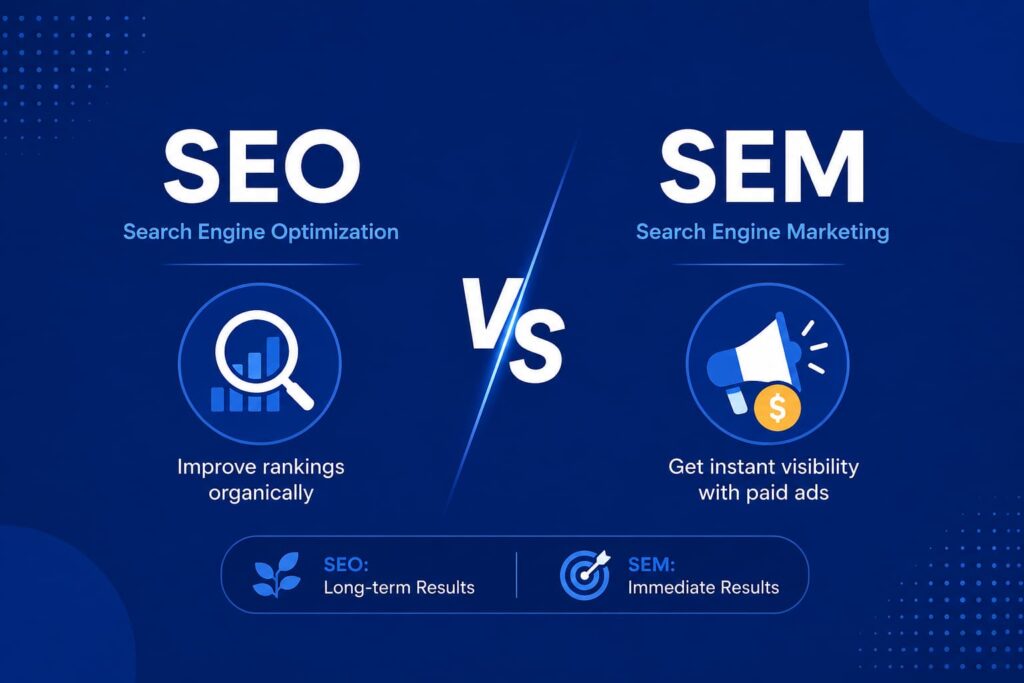
SEO (Search Engine Optimization) is the process of improving your website so it ranks higher in the organic (free) search results.
Instead of paying for clicks, SEO focuses on creating high-quality content and optimizing your website according to search engine guidelines.
SEO Includes
- Keyword research
- On-page SEO
- Technical SEO
- Off-page SEO
- Link building
- Mobile optimization
- Website speed improvements
- Content optimization
Benefits of SEO
- Free organic traffic
- Long-term results
- Higher credibility
- Better user experience
- Improved website authority
- Higher return on investment over time
Drawbacks of SEO
- Takes time to show results
- Requires continuous optimization
- High competition for popular keywords
What Is SEM?
SEM (Search Engine Marketing) is a broader digital marketing strategy SEO vs SEM. that uses paid advertising to appear at the top of search engine results.
The most common SEM platform is Google Ads, where advertisers bid on keywords and pay whenever someone clicks on their advertisement.
SEM Includes
- Google Search Ads
- Display Ads
- Shopping Ads
- Remarketing Campaigns
- Local Search Ads
Benefits of SEM
- Instant visibility
- Immediate website traffic
- Highly targeted audience
- Flexible budget
- Easy performance tracking
Drawbacks of SEM
- Costs money for every click
- Traffic stops when your budget runs out
- Competitive keywords can be expensive
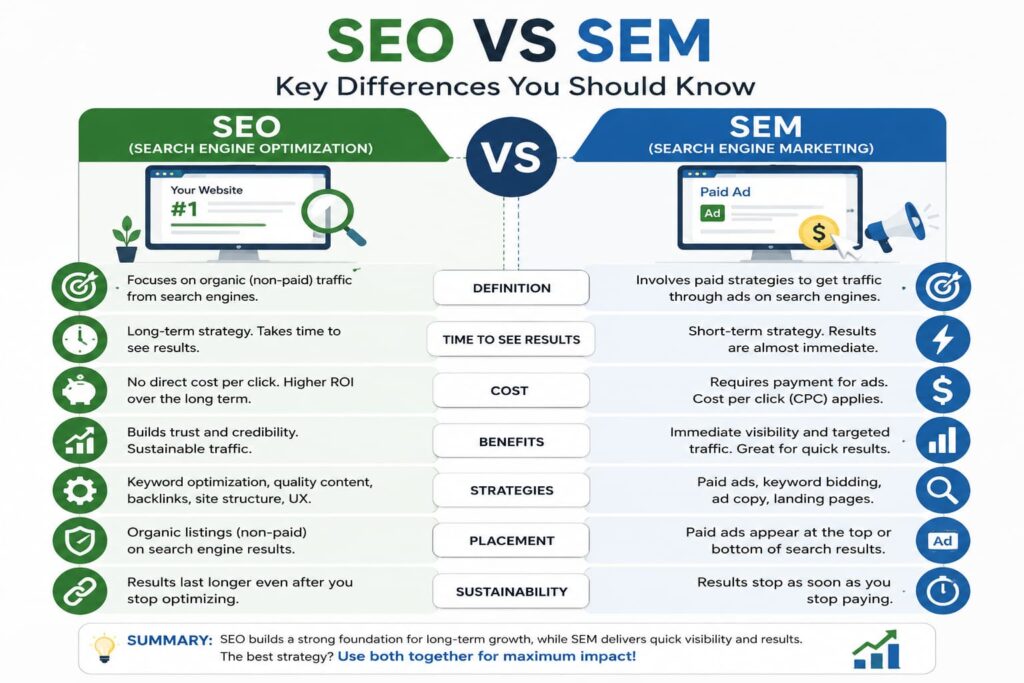
SEO vs SEM: Key Differences
SEO and SEM are two different approaches to gaining visibility on search engines like Google, and understanding their difference comes down to understanding how you get that visibility and what it costs you.
SEO (Search Engine Optimization) is the practice of improving your website so that it ranks higher in the organic, unpaid search results — the listings that appear because a search engine’s algorithm judged them the most relevant and trustworthy for a given query, not because SEO VS SEM anyone paid for placement. Achieving this involves several layers of work: researching what keywords your audience actually searches for, optimizing on-page elements like titles, headers, and content quality, improving technical factors such as site speed and mobile usability, and building backlinks from other
SEM (Search Engine Marketing), in its most common modern usage, refers to paid advertising on search engines — think Google Ads — where businesses bid on keywords so their ads appear at the top of search results, usually marked “Sponsored” or “Ad.” Unlike SEO, SEM delivers immediate results: as soon as your campaign is approved and live, your ad can start appearing and driving traffic. But this visibility is tied directly to spending — you’re typically charged per click (PPC) or per impression, and the moment your budget runs out or your campaign pauses, your visibility disappears. SEM requires ongoing management of bids, ad copy, targeting, and budget to remain cost-effective, and results can scale quickly but also become expensive in competitive industries.
The core distinction, then, is organic versus paid, and slow-but-lasting versus fast-but-temporary. SEO builds an asset over time that keeps generating traffic without a direct cost per visitor, while SEM buys traffic on demand but stops the moment you stop paying. SEO VS SEM It’s also worth noting that SEM is sometimes used as a broader umbrella term encompassing both organic and paid search strategies, but in everyday marketing conversations, people almost always use “SEM” to mean the paid side specifically, treating SEO as its own distinct discipline.
In practice, most effective digital marketing strategies use both together SEM to generate immediate traffic and test which keywords convert well, while SEO builds a durable foundation of organic visibility that reduces long-term dependence on ad spend. SEO VS SEM If you’re launching a new site or product and need visitors now, SEM fills that gap while your SEO efforts mature in the background.
Cost structure and ROI over time
With SEO, your “cost” is mostly labor and expertise — content creation, technical audits, link-building outreach — rather than a direct payment per visitor. This means the marginal cost of an additional visitor trends toward zero once a page ranks well, since you’re not paying Google each time someone clicks through. The catch is the upfront investment can be substantial with no guaranteed timeline, especially in competitive niches where established sites have years of accumulated authority. SEM flips this: cost is direct and immediate (you pay per click regardless of conversion),
There’s also a data and learning dimension worth considering. SEM campaigns generate rich, immediate data — click-through rates, conversion rates, cost per acquisition — all trackable in real time, which makes it easier to test messaging, offers, and targeting quickly. This data can actually inform SEO strategy too, since knowing which keywords convert well in paid campaigns can guide which topics are worth investing in for organic content. SEO data, on the other hand, tends to be slower and noisier to interpret — ranking fluctuations can result from algorithm updates, seasonal search trends, or competitor changes, making it harder to isolate cause and effect compared to the relatively clean feedback loop of paid campaigns.
Trust and click-through behavior
Users tend to trust organic results more than paid ones, largely because organic rankings feel “earned” rather than bought. Studies on search behavior consistently SEO VS SEM show a majority of clicks go to organic listings, particularly for informational or research-driven searches. Paid ads perform better for high-intent, transactional searches — someone searching “buy running shoes size 10” close to a purchase decision is often more likely to click a well-targeted ad than someone doing broader research like “best running shoes for flat feet,” which tends to favor organic content that goes into depth.
- Control and flexibility
SEM gives you granular control: you can target specific locations, times of day, devices, demographics, and even pause or adjust campaigns instantly if something seo vs sem.
isn’t working. SEO offers far less immediate control you can’t force a ranking position, and algorithm updates (which Google rolls out frequently) can shift your rankings without warning, sometimes undoing months of work. This unpredictability is a real risk with SEO that SEM doesn’t share, since ad placement is transactional and rule-based rather than algorithmically judged for “quality.”
Skill sets involved
SEO leans heavily on content strategy, technical web knowledge (site architecture, page speed, structured data), and relationship-building for backlinks. SEM leans more toward copywriting for ads, bid strategy, audience segmentation, and continuous A/B testing of landing pages. Teams SEO VS SEM sometimes specialize separately in each because the day-to-day work looks quite different, even though both ultimately serve the same goal of search visibility.
Another important distinction lies in scalability and predictability. SEM is highly scalable in the short term — if a campaign is profitable, you can often increase budget and see a roughly proportional increase in traffic, at least until you hit market saturation or rising costs from increased competition for the same keywords. SEO scalability is messier and less linear; producing twice as much content doesn’t guarantee twice the traffic,
There’s also a data and learning dimension worth considering. SEM campaigns generate rich, immediate data click-through rates, conversion rates, cost per acquisition all trackable in real time, which makes it easier to test messaging, offers, and targeting quickly. This data can actually SEO VS SEM inform SEO strategy too, since knowing which keywords convert well in paid campaigns can guide which topics are worth investing in for organic content. SEO data, on the other hand, tends to be slower and noisier to interpret ranking fluctuations can result from algorithm updates, s.
Finally, the risk profile differs significantly between the two. SEM risk is primarily financial and immediate — if a campaign underperforms, you can lose money quickly, but you can also stop the bleeding instantly by pausing it. SEO risk is more structural and long-term a Google algorithm update, a penalty from violating search guidelines (like using manipulative backlink schemes), or simply falling behind competitors in content quality can quietly erode months or years of accumulated traffic, and recovery can take just as long, if not longer, than the original ranking effort..
When each makes more sense
- New business/website with no traffic history: SEM is often necessary early on since SEO needs time to build authority.
- Established brand with existing content: SEO becomes increasingly cost-effective as accumulated content and backlinks keep generating free traffic.
- Seasonal or time-limited campaigns (holiday sales, product launches): SEM is far more practical since SEO can’t react fast enough.
- Long-term brand-building and thought leadership: SEO wins because it builds durable authority and trust that ads alone can’t replicate.
| Feature | SEO | SEM |
|---|---|---|
| Cost | Free traffic | Paid traffic |
| Speed | Slow | Immediate |
| Results | Long-term | Short-term |
| Click Cost | No | Yes (Pay-Per-Click) |
| Sustainability | High | Budget-dependent |
| Traffic Source | Organic | Paid Ads |
| Best For | Long-term growth | Instant traffic |
SEO vs SEM: Which One Is Better?
The answer depends on your goals.
Choose SEO if you want:
- Long-term website growth
- Free organic traffic
- Better brand authority
- Sustainable online presence
- Higher ROI over time
Choose SEM if you want:
- Immediate website visitors
- Quick lead generation
- Product launches
- Time-sensitive promotions
- Fast testing of keywords
Can SEO and SEM Work Together?
Absolutely.
The best digital marketing strategy combines SEO and SEM.
For example:
- Use SEM to drive instant traffic to new pages.
- Use SEO to build long-term rankings.
- Analyze paid keyword performance SEO VS SEM and optimize organic content.
- Retarget visitors through paid advertising while growing organic traffic.
This combination often delivers the strongest results.
SEO vs SEM: Cost Comparison
SEO Costs
Although organic clicks are free, SEO may involve costs such as:
- Content creation
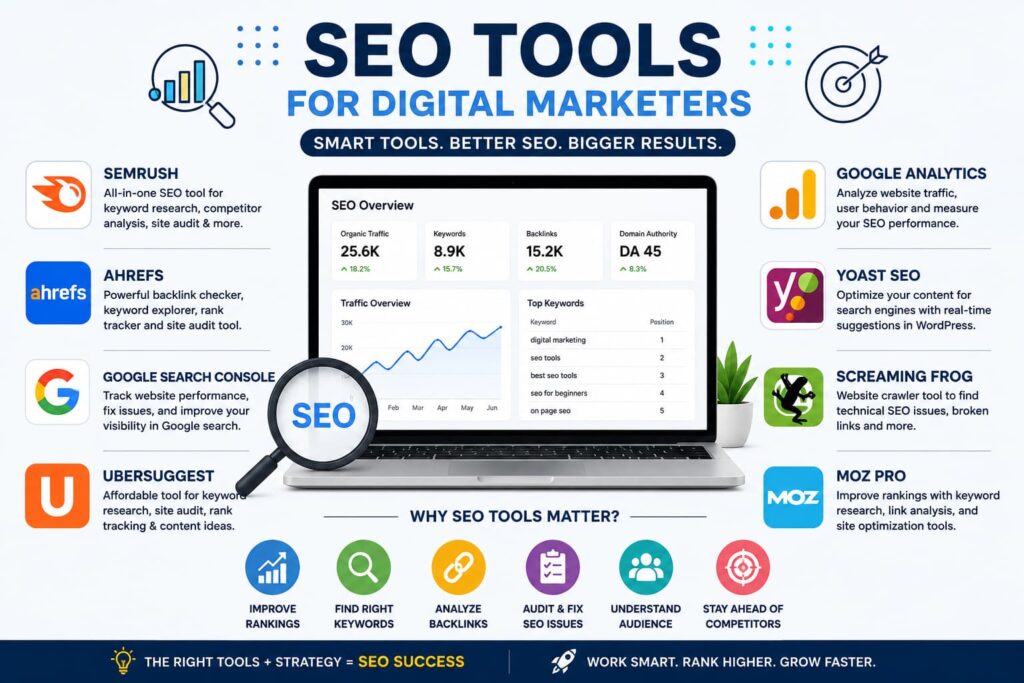
- SEO tools
- Website optimization
- Link building
- Professional SEO services
However, once your pages rank well, they can continue generating traffic without paying for every click.
SEM Costs
SEM typically requires:
- Daily or monthly advertising budget
- Keyword bidding
- Campaign management
- Ad copy creation
- Landing page optimization
Costs vary depending on your industry and keyword competition.
SEO vs SEM: When Should You Use Each?
Use SEO When:
- Building a new website
- Growing a blog
- Improving brand authority
- Targeting informational keywords
- Seeking sustainable traffic
Use SEM When:
- Launching a new product
- Running seasonal campaigns
- Promoting limited-time offers
- Generating leads quickly
- Competing in highly competitive markets
Common SEO vs SEM Myths
Myth 1: SEO Is Free
While clicks are free, SEO requires time, expertise, and resources.
Myth 2: SEM Guarantees Sales
Paid ads increase visibility, but conversions depend on your offer, landing page, and user experience.
Myth 3: SEO Is Dead
SEO continues to evolve and remains one of the most effective long-term digital marketing strategies.
Myth 4: SEM Replaces SEO
SEM complements SEO but doesn’t replace the value of organic rankings.
SEO Checklist for the Focus Keyword “SEO vs SEM”
- ✅ Focus keyword in the SEO title
- ✅ Focus keyword in the URL (
/seo-vs-sem/) - ✅ Focus keyword in the H1
- ✅ Focus keyword in the first paragraph
- ✅ Focus keyword in multiple H2 headings
- ✅ Focus keyword in the conclusion
- ✅ Focus keyword in the meta description
- ✅ Image ALT text includes “SEO vs SEM”
- ✅ FAQ section optimized for featured snippets
- ✅ Schema markup (Article + FAQ)
- ✅ Internal linking opportunities included
- ✅ Keyword density around 1–1.5%
- ✅ Readability optimized with short paragraphs SEO VS SEM and headings
This structure is well-optimized for WordPress SEO plugins such as Yoast SEO, Rank Math, and All in One SEO,
Best Practices for SEO and SEM
To maximize results:
- Conduct thorough keyword research.
- Optimize landing pages.
- Improve website speed.
- Create valuable, user-focused content.
- Track performance using analytics tools.
- Test different ad variations.
- Monitor conversion rates.
- Continuously update your SEO strategy.
Suggested Table of Contents
- What Is SEO?
- What Is SEM?
- SEO vs SEM: Key Differences
- SEO vs SEM Comparison Table
- Pros and Cons of SEO
- Pros and Cons of SEM
- When Should You Choose SEO?
- When Should You Choose SEM?
- Can SEO and SEM Work Together?
- Frequently Asked Questions
- Conclusion
Internal Linking Opportunities
Link this article to your related content:
- What Is SEO?
- Types of SEO
- On-Page SEO Guide
- Off-Page SEO Guide
- Technical SEO Checklist
- Keyword Research Guide
- Local SEO Tips
- Best Free SEO Tools
- Google Search Console Guide
Suggested External Links
- Google Search Central
- Google Ads Help
- Google Analytics
Image Alt Text
- SEO vs SEM comparison infographic
- SEO vs SEM differences explained
- Organic SEO vs Paid SEM
- Search engine optimization vs search engine marketing
- SEO and SEM comparison chart
FAQ Schema Questions
What is the difference between SEO and SEM?
SEO focuses on improving organic search rankings, while SEM uses paid advertisements to appear in search engine results.
Is SEO better than SEM?
SEO is better for long-term growth, whereas SEM is ideal for immediate visibility and quick results.
Can SEO and SEM work together?
Yes. Combining SEO and SEM helps businesses gain instant traffic while building sustainable organic rankings.
Does SEM include SEO?
Traditionally, SEM included SEO,
but today SEM commonly refers to paid search advertising, while SEO focuses on organic optimization.
Which is more cost-effective?
SEO offers better long-term ROI, while SEM provides faster results but requires continuous advertising investment.
Related Keywords
- SEO vs SEM
- SEO and SEM difference
- Difference between SEO and SEM
- SEO vs PPC
- Organic vs paid search
- Search engine optimization
- Search engine marketing
- Google Ads vs SEO
- SEO benefits
- SEM benefits
- Digital marketing strategies
- Organic search vs paid search
- SEO guide for beginners
- SEM guide
- Paid search advertising
Recommended Keyword Placement
Use the focus keyword SEO vs SEM in the following locations:
- ✅ SEO Title
- ✅ URL Slug
- ✅ H1 Heading
- ✅ First 100 words
- ✅ At least one H2 heading
- ✅ One image ALT tag
- ✅ Meta description
- ✅ Conclusion
- ✅ FAQ section
This optimization provides a strong on-page SEO structure while keeping the article natural and user-friendly.
Is SEO better than SEM?
Neither is universally better. SEO is ideal for long-term organic growth, while SEM is best for immediate visibility and quick traffic.
Can I use SEO and SEM together?
Yes. Combining both strategies helps generate immediate traffic while building sustainable organic rankings over time.
Does SEM include SEO?
Yes. Search Engine Marketing is often used as an umbrella term for search marketing, though in practice many marketers use “SEM” specifically to refer to paid search advertising.
Which is more cost-effective?
SEO generally provides a better long-term return on investment, while SEM offers faster results but requires ongoing ad spend.
How long does SEO take?
Most websites begin seeing noticeable improvements within 3–6 months, though timelines vary based on competition, website authority, and content quality.
Conclusion
Understanding SEO vs SEM helps you choose the right strategy for your business goals. SEO focuses on earning free, organic traffic through quality content and website optimization, while SEM uses paid advertising to generate immediate visibility and clicks.
For the best results, don’t think of SEO and SEM as competitors. Instead, use them together—SEM can deliver quick wins, while SEO builds lasting online visibility. A balanced strategy allows you to attract both immediate and long-term traffic, helping your business grow more effectively.