
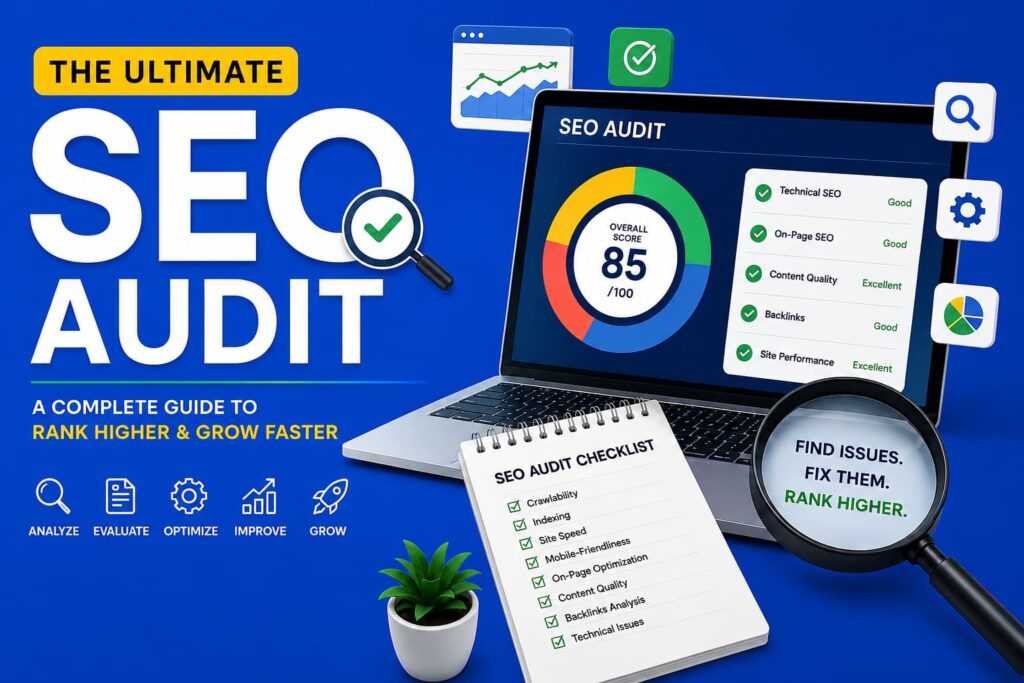

An SEO audit is the foundation of every successful digital marketing strategy. It helps you identify technical issues, improve your website’s performance, enhance user experience, and increase your search engine rankings SEO audit guide. Whether you’re managing a personal blog, an eCommerce store, or a business website, conducting regular SEO audits guide ensures your site remains optimized for both search engines and users.
What Is an SEO Audit?
An SEO audit guide is a detailed evaluation of your website to identify factors that affect its visibility in search engine results. It examines technical SEO, on-page SEO, content quality, backlinks, user experience, and overall website health.
The primary goal is to uncover issues preventing your website from achieving higher rankings and to create a roadmap for improvement.
Why Is an SEO Audit Important?

- Improve search engine rankings
- Increase organic traffic
- Fix technical SEO issues
- Enhance user experience
- Discover content gaps
- Improve website speed
- Strengthen backlink quality
- Stay updated with Google’s algorithm changes
Without regular audits, even well-designed websites can lose rankings over time.
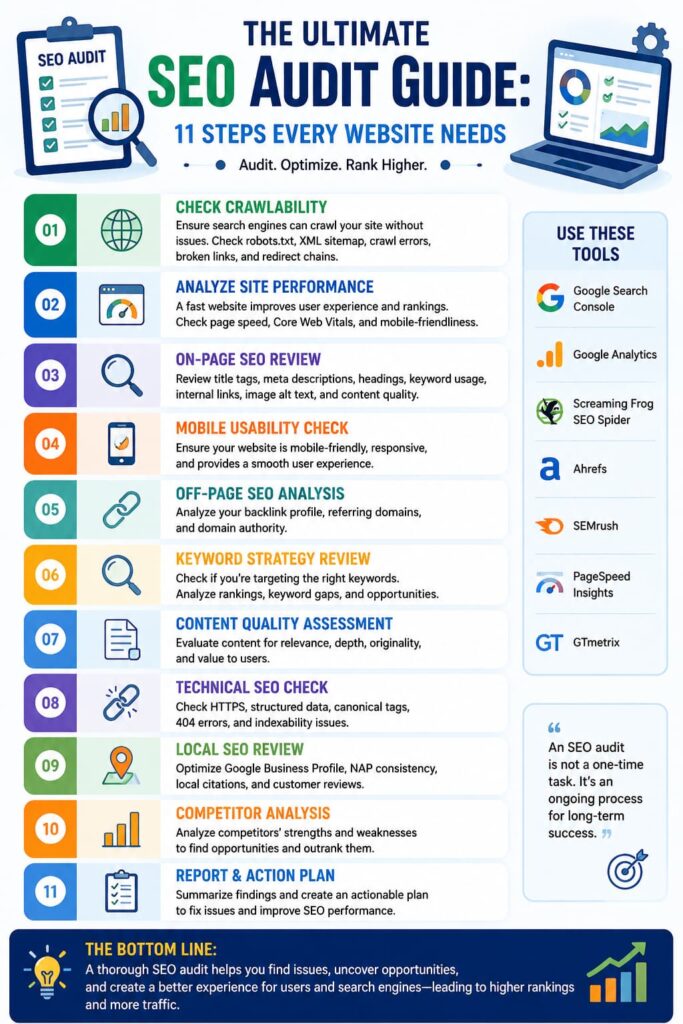
SEO Audit Guide Step 1: Check Website Crawlability
Website crawlability is the first and most important step in any SEO Audit Guide. Before your web pages can appear in search results, SEO audit guide search engines like Google need to discover and crawl them. Crawling is the process where search engine bots, often called spiders, visit your website, follow links, and collect information about your pages. If search engines cannot crawl your website effectively, your content may never be indexed or ranked, no matter how valuable it is.
A crawlability audit helps identify barriers that prevent search engine bots from accessing your website. Fixing these issues ensures your important pages are visible to search engines, improving your chances of ranking higher in search results.
What to Check During a Crawlability Audit
The file tells search engine crawlers which pages or sections of your website they can or cannot access. While it is useful for blocking duplicate, SEO audit guide private, or low-value pages, an incorrectly configured robots.txt file can accidentally block important pages from being crawled.
Review your robots.txt file to ensure that:
- Essential pages are not blocked.
- Sensitive pages are restricted when necessary.
- Sitemap URLs are included.
- There are no accidental “Disallow” directives affecting key content.
SEO Audit Guide Step 2: Review Indexing Status
After search engines crawl your website, they decide whether to add each page to their index. Indexing is the process of storing your pages in Google’s database so they can appear in search results.
Even a perfectly optimized page cannot rank if it isn’t indexed. That’s why reviewing indexing status is a crucial step in any SEO Audit Guide.
What to Check
Indexed Pages
Compare the number of indexed pages with the actual number of pages on your website.
If many important pages are missing from Google’s index, investigate the cause immediately.
Noindex Tags
The “noindex” directive tells search engines not to include a page in search results.
Ensure that:
- Important landing pages are not marked as noindex.
- Temporary or duplicate pages use noindex when appropriate.
Duplicate URLs
Multiple URLs displaying identical content confuse search engines and dilute ranking signals.
Examples include:
- HTTP vs HTTPS
- WWW vs non-WWW
- URLs with tracking parameters
- Printer-friendly versions
Consolidate duplicate pages using canonical tags or redirects.
Canonical Tags
Canonical tags tell search engines which version of a page is the preferred one.
Verify that canonical tags:
- Point to the correct URL.
- Are consistent across your website.
- Avoid self-conflicting signals.
Excluded Pages
Google may exclude pages due to:
- Soft 404 errors
- Duplicate content
- Crawl anomalies
- Redirects
- Blocked resources
Review exclusion reports in Google Search Console to identify pages that require action.
SEO Audit Guide Tip
Monitor your indexing status monthly SEO audit guide. New pages should be indexed promptly, while outdated or duplicate pages should be removed or consolidated to keep your index clean and efficient.
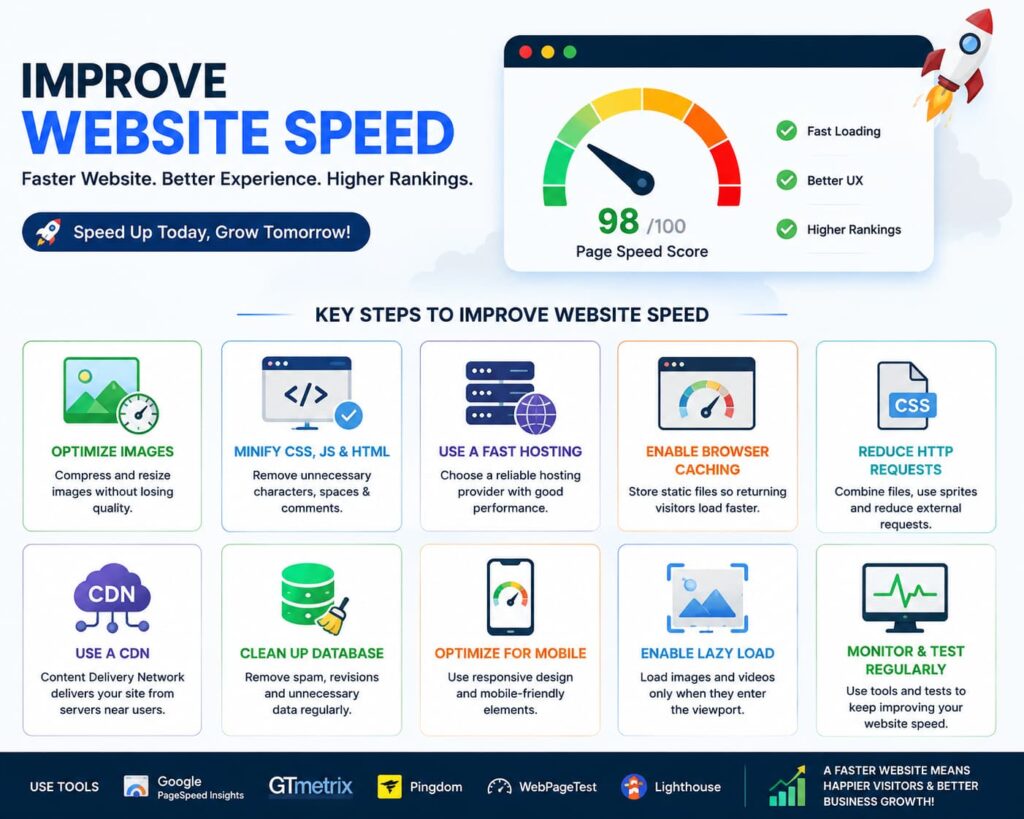
SEO Audit Guide Step 3: Improve Website Speed
Website speed is one of the most important ranking factors and a key element of user experience. A slow website frustrates visitors, increases bounce rates, and reduces conversions. Every comprehensive SEO Audit Guide should include a detailed page speed analysis.
Google uses Core Web Vitals to measure how quickly and smoothly your website performs for users.
Analyze Core Web Vitals
Largest Contentful Paint (LCP)
LCP measures how long it takes for the largest visible element on a page to load. For a good user experience, aim for an LCP of 2.5 seconds or less.
First Input Delay (FID)
FID measures the delay between a user’s SEO audit guide first interaction and the browser’s response. Although Google has begun replacing FID with Interaction to Next Paint (INP), understanding FID can still provide insight into responsiveness.
Interaction to Next Paint (INP)
INP evaluates how quickly your website responds to user interactions such as clicks, taps, or keyboard input. Lower INP values indicate a more responsive website.
Cumulative Layout Shift (CLS)
CLS measures visual stability. A high CLS score means elements move unexpectedly while the page loads, which can frustrate users and lead to accidental clicks.
Improve Website Speed By
- Compressing large images before uploading.
- Using next-generation image formats like WebP.
- Enabling browser caching.
- Implementing a Content Delivery Network (CDN).
- Minifying CSS, JavaScript, and HTML files.
- Removing unused code and plugins.
- Reducing server response time.
- Enabling GZIP or Brotli compression.
- Using lazy loading for images and videos.
SEO Audit Guide Tip
Test your website speed regularly on both desktop and mobile devices. Small performance improvements can significantly enhance user satisfaction and search rankings.
SEO Audit Guide Step 4: Ensure Mobile Friendliness
Mobile devices now account for the majority of global web traffic, making mobile optimization an essential part of any SEO Audit Guide. Google primarily uses the mobile version of your website for indexing and ranking through mobile-first indexing.
A website that performs well on desktop but poorly on mobile may struggle SEO audit guideto achieve strong search rankings.
What to Check
Responsive Design
Your website should automatically adapt to different screen sizes without compromising usability or readability.
Mobile Usability
Ensure that users can easily navigate your website on smartphones and tablets. Menus, buttons, and forms should be simple to use with touch controls.
Font Size
Text should be large enough to read comfortably without zooming. Small fonts can frustrate users and increase bounce rates.
Clickable Elements
Buttons and links should have enough spacing SEO audit guideto prevent accidental taps. Interactive elements should be easy to access on smaller screens.
Mobile Page Speed
Mobile users expect fast-loading pages, even on slower networks. Optimize images, reduce unnecessary scripts, and streamline your design to improve loading times.
Why Mobile Friendliness Matters
A mobile-friendly website provides:
- Better user experience.
- Lower bounce rates.
- Higher engagement.
- Improved search rankings.
- Increased conversions.
SEO Audit Guide Tip
Review your website on multiple devices and screen sizes. A seamless mobile experience not only satisfies visitors but also supports stronger SEO performance.
Next Part: I’ll continue with SEO Audit Guide Steps 5–8 (On-Page SEO, Content Quality, Technical SEO, and Backlink Profile) in the same detailed, SEO-optimized format.
Continue writing please
SEO Audit Guide Step 5: Audit On-Page SEO
On-page SEO is one of the most important components of any SEO Audit Guide because it directly affects how search engines understand your content and how users interact with your website. Every page on your website should be optimized around a primary keyword while providing valuable, relevant, and engaging information that satisfies user intent.
A thorough on-page SEO audit ensures that every element on your page contributes to better rankings, higher click-through rates, and an improved user experience.
What to Review During an On-Page SEO Audit
Title Tags
Title tags are one of the strongest on-page ranking signals SEO audit guide. They tell both users and search engines what your page is about. A compelling, keyword-rich title can significantly improve your visibility in search results.
When reviewing title tags, ensure that they:
- Include the primary keyword naturally.
- Stay within 50–60 characters.
- Are unique for every page.
- Accurately describe the page content.
- Encourage users to click.
Avoid generic or duplicate titles, as they can reduce your page’s effectiveness in search results.
Meta Descriptions
Although meta descriptions are not a direct ranking factor, they influence click-through rates. A well-written meta description gives users a compelling reason to visit your page.
A strong meta description should:
- Be approximately 150–160 characters long.
- Include the target keyword naturally.
- Summarize the page content clearly.
- Include a call to action when appropriate.
- Be unique for every page.
URL Structure
Clean, descriptive URLs are easier for both users and search engines to understand.
A good URL should:
- Be short and readable.
- Include the primary keyword.
- Avoid unnecessary numbers and symbols.
- Use hyphens instead of underscores.
- Reflect the page hierarchy.
Well-structured headings make long-form content easier to scan and improve the user experience.
Keyword Placement
Keyword optimization is essential, but it should always sound natural.
Include your primary keyword in:
- Title tag
- Meta description
- H1 heading
- First paragraph
- Subheadings where appropriate
- Image alt text
- URL
- Conclusion
Use related keywords and semantic phrases to avoid keyword stuffing while improving topical relevance.
Internal Linking
Internal links connect related pages across your website, helping search engines discover content and distribute authority.
Review:
- Relevant contextual links.
- Broken internal links.
- Anchor text optimization.
- Link depth.
- Important pages receiving sufficient internal links.
A strong internal linking strategy improves navigation and supports better rankings.
Image Alt Text
Search engines cannot interpret images SEO audit guide the way humans can. Alt text provides context and improves accessibility.
Ensure that every important image:
- Has descriptive alt text.
- Includes keywords naturally when relevant.
- Accurately describes the image.
- Avoids keyword stuffing.
Optimized images can also help your website rank in Google Images.
SEO Audit Guide Tip
Avoid over-optimizing your pages with excessive keywords. Instead, focus on creating content that answers users’ questions thoroughly while naturally incorporating your target keywords.
SEO Audit Guide Step 6: Evaluate Content Quality
Content is the foundation of every successful SEO strategy. Even the most technically optimized website cannot achieve sustainable rankings without high-quality content. That’s why content evaluation is a critical step in any SEO Audit Guide.
Google prioritizes content that demonstrates expertise, experience, authority, and trustworthiness while satisfying user intent.
What to Check During a Content Audit
Thin Content
Thin content provides little value to users and often struggles to rank well.
Examples include:
- Very short articles.
- Pages with little original information.
- Automatically generated content.
- Low-quality category pages.
Expand thin pages with useful information, examples, visuals, FAQs, and practical insights.
Duplicate Content
Duplicate content occurs when identical or nearly identical information appears on multiple pages.
This may happen because of:
- URL variations.
- Product descriptions.
- Printer-friendly pages.
- Copied content.
Consolidate duplicate pages using canonical tags or redirects to prevent ranking issues.
Outdated Information
SEO is constantly evolving. Statistics, tools, algorithms, and best practices change over time.
Review older content regularly by:
- Updating facts and data.
- Adding recent examples.
- Replacing outdated screenshots.
- Improving recommendations.
Fresh content signals relevance to both users and search engines.
Keyword Relevance
Ensure every page targets a clear primary keyword while also including related terms that support the topic naturally.
Avoid creating multiple pages targeting the same keyword, as this can lead to keyword cannibalization.
Search Intent Alignment
Your content should satisfy the user’s purpose behind the search query.
Ask yourself:
- Does the content answer the user’s question?
- Is it more helpful than competing pages?
- Does it solve a specific problem?
- Does it meet informational, commercial, or transactional intent?
Matching search intent is one of the strongest predictors of SEO success.
Readability
Great content is easy to read and understand.
Improve readability by:
- Writing short paragraphs.
- Using descriptive headings.
- Including bullet points and numbered lists.
- Highlighting important information.
- Using simple, conversational language.
Readable content encourages visitors to stay longer on your website.
Content Freshness
Regular updates help maintain rankings and improve user trust.
Consider updating:
- Statistics.
- Examples.
- Internal links.
- External references.
- Images.
- FAQs.
Content that remains current is more likely to retain its search visibility.
SEO Audit Guide Tip
Perform a content audit every six to twelve months. Updating existing high-performing content is often more effective than creating new content from scratch.
SEO Audit Guide Step 7: Analyze Technical SEO
Technical SEO ensures that your website is easy for search engines to crawl, index, and understand. A technically sound website provides the foundation for all other SEO efforts. Every complete SEO Audit Guide should include a detailed technical SEO review.
Even excellent content may struggle to rank if technical issues prevent search engines from accessing it properly.
What to Review
HTTPS Security
Security is a ranking signal and an essential trust factor.
Ensure that:
- Your website uses HTTPS.
- SSL certificates are valid.
- Mixed content warnings are eliminated.
- All HTTP pages redirect to HTTPS.
Visitors are more likely to trust secure websites.
Structured Data
Structured data helps search engines understand your content and can improve visibility through rich results.
Common schema types include:
- Article
- FAQ
- Product
- Organization
- Local Business
- Breadcrumb
- Review
Correct schema implementation may increase click-through rates by enhancing your search listings.
Canonical URLs
Canonical tags prevent duplicate content issues by indicating the preferred version of a page.
Check that:
- Every canonical tag points to the correct page.
- Self-referencing canonicals are used where appropriate.
- Duplicate pages reference the preferred version.
XML Sitemap
A sitemap helps search engines discover important pages efficiently.
Review your sitemap to ensure:
- It contains only indexable pages.
- Broken URLs are removed.
- New pages are added automatically.
- It is submitted to Google Search Console.
Robots.txt
Confirm that your robots.txt file blocks unnecessary pages without restricting important content.
Incorrect configurations can prevent valuable pages from being indexed.
Redirects
Review all redirects to identify:
- Redirect chains.
- Redirect loops.
- Temporary redirects that should be permanent.
- Broken redirects.
Pagination
Large websites often use pagination for category pages and blogs.
Ensure pagination:
- Is crawlable.
- Maintains logical navigation.
- Does not create duplicate content issues.
SEO Audit Guide Tip
Conduct a full technical SEO audit at least every quarter, especially after redesigns, migrations, or significant content updates.
SEO Audit Guide Step 8: Inspect Backlink Profile
Backlinks remain one of Google’s most influential ranking factors. They act as votes of confidence from other websites, signaling that your content is valuable and trustworthy. A comprehensive SEO Audit Guide should always include a detailed backlink analysis.
However, not all backlinks are beneficial. High-quality links can strengthen your rankings, while spammy or toxic links may harm your website’s authority.
What to Evaluate
Total Backlinks
Review the total number of backlinks pointing to your website.
A growing backlink profile generally indicates increasing authority, but quality is more important than quantity.
Referring Domains
Focus on the number of unique websites linking to your content.
Backlinks from diverse, authoritative domains carry greater SEO value than multiple links from the same website.
Link Quality
Evaluate each backlink based on:
- Domain authority.
- Relevance to your niche.
- Editorial placement.
- Anchor text.
- Traffic potential.
Prioritize links from trusted, high-quality websites.
Toxic Backlinks
Identify spammy backlinks that may negatively affect your SEO.
Examples include:
- Link farms.
- Spam directories.
- Irrelevant websites.
- Paid link schemes.
- Automated backlinks.
Disavow harmful backlinks only when necessary and after careful evaluation.
Lost Backlinks
Monitor backlinks that have been removed or no longer point to your website.
Recovering valuable lost links can restore authority and improve rankings.
Anchor Text Diversity
Anchor text should appear natural and varied.
Maintain a healthy mix of:
- Branded anchors.
- Exact-match keywords.
- Partial-match keywords.
- Generic anchors.
- Naked URLs.
Overusing exact-match keywords can appear manipulative to search engines.
SEO Audit Guide Tip
Focus on earning backlinks through valuable content, digital PR, guest posting, original research, and useful resources. High-quality backlinks built naturally provide long-term SEO benefits and strengthen your website’s authority.
Next Part: I’ll continue with SEO Audit Guide Steps 9–11, Best SEO Audit Tools, Common SEO Issues to Fix Immediately, SEO Audit Checklist, and a detailed Final Thoughts section.
Continue writing please
SEO Audit Guide Step 9: Optimize Internal Linking
Internal linking is one of the most overlooked yet powerful strategies in any SEO Audit Guide. Internal links connect one page of your website to another, helping search engines understand your site’s structure while guiding visitors to relevant content. A well-planned internal linking strategy improves crawlability, distributes page authority, and enhances the overall user experience.
Search engines use internal links to discover new pages and determine the relationship between different pieces of content. Without proper internal linking, valuable pages may remain hidden or receive less authority, making it harder for them to rank.
What to Check During an Internal Linking Audit
Broken Internal Links
Broken internal links lead users and search engine crawlers to pages that no longer exist. These links create a poor browsing experience and waste your website’s crawl budget.
Review your website regularly to identify:
- Broken blog post links
- Broken category page links
- Missing landing pages
- Incorrect navigation links
- Broken image links
Replace or redirect broken links to maintain a seamless user experience.
Orphan Pages
Orphan pages are pages that have no internal links pointing to them. Since search engines rely on internal links to discover content, these pages often receive little or no organic visibility.
To fix orphan pages:
- Link them from relevant blog posts.
- Add them to category pages.
- Include them in your website navigation where appropriate.
- Connect them through contextual links.
Every important page should have at least one internal link directing users and search engines to it.
Anchor Text Relevance
Anchor text is the clickable text used in a hyperlink. Descriptive and relevant anchor text helps search engines understand the destination page’s topic.
Instead of generic phrases like:
- Click here
- Read more
- Learn more
Use descriptive anchor text such as:
- Complete SEO Audit Guide
- Technical SEO Checklist
- Keyword Research Tips
- On-Page SEO Best Practices
Natural anchor text improves both accessibility and SEO.
Navigation Structure
A clear navigation structure helps users find information quickly while allowing search engines to crawl your website more efficiently.
Review your:
- Main navigation menu
- Footer links
- Category pages
- Breadcrumb navigation
- Sidebar links
Keep navigation simple, logical, and user-friendly.
Link Depth
Link depth refers to the number of clicks required to reach a page from your homepage.
Important pages should ideally be accessible within three clicks. Pages buried deep within your website are less likely to receive sufficient authority and may be crawled less frequently.
Reduce unnecessary layers of navigation and ensure high-value pages are easy to access.
Benefits of Strong Internal Linking
An effective internal linking strategy can:
- Improve website crawlability.
- Distribute page authority across your website.
- Increase page views.
- Reduce bounce rates.
- Help users discover related content.
- Improve keyword relevance.
- Strengthen topic clusters.
SEO Audit Guide Tip
Whenever you publish a new article, link it to older relevant content, and update older articles with links to the new page. This creates a strong internal linking network that benefits both users and search engines.
SEO Audit Guide Step 10: Review User Experience (UX)
User experience has become an increasingly important ranking factor, making it a critical part of any SEO Audit Guide. Google aims to rank websites that provide users with a fast, engaging, and enjoyable browsing experience.
Even if your website ranks well initially, poor user experience can lead to higher bounce rates, lower engagement, and reduced search visibility over time.
What to Evaluate During a UX Audit
Navigation Simplicity
Visitors should be able to find the information they need quickly without feeling overwhelmed.
Evaluate:
- Menu organization
- Category structure
- Search functionality
- Clear navigation labels
- Logical page hierarchy
Simple navigation improves usability and encourages visitors to explore more pages.
Page Layout
A clean layout improves readability and keeps visitors engaged.
Ensure that:
- Important information appears above the fold.
- White space is used effectively.
- Images support the content.
- Headings break up long sections.
- Visual elements guide the user’s attention.
Avoid cluttered pages with excessive advertisements or distracting elements.
Readability
Content should be easy to read across all devices.
Improve readability by:
- Using short paragraphs.
- Writing concise sentences.
- Adding bullet points.
- Including descriptive headings.
- Highlighting key information.
Readable content keeps visitors engaged and increases time spent on your website.
Calls-to-Action (CTAs)
Every important page should encourage users to take the next step.
Examples include:
- Contact us
- Download our guide
- Subscribe to our newsletter
- Request a free consultation
- Shop now
Well-designed CTAs improve conversions while guiding users through your website.
Accessibility
Accessible websites provide a better experience for all users, including those with disabilities.
Review:
- Image alt text
- Keyboard navigation
- Color contrast
- Font size
- Screen reader compatibility
- Accessible forms
Accessibility improvements often enhance overall usability as well.
Bounce Rate
Bounce rate measures the percentage of visitors who leave your website without interacting further.
A high bounce rate may indicate:
- Slow loading pages
- Poor content quality
- Irrelevant search intent
- Difficult navigation
- Weak page design
Identify high-bounce pages and improve their content and user experience.
Time on Page
The amount of time visitors spend on a page can indicate how engaging and valuable your content is.
Increase engagement by:
- Providing detailed information.
- Using visuals.
- Embedding videos.
- Including FAQs.
- Linking to related articles.
Longer engagement often signals content quality to search engines.
Why User Experience Matters
Excellent user experience leads to:
- Higher engagement
- Lower bounce rates
- Increased conversions
- Better customer satisfaction
- Stronger search rankings
Google rewards websites that prioritize users over search engines.
SEO Audit Guide Tip
Regularly test your website from a visitor’s perspective. Ask yourself whether the content is easy to find, read, and interact with. Small UX improvements can significantly impact both SEO and conversions.
SEO Audit Guide Step 11: Monitor SEO Performance
An effective SEO Audit Guide doesn’t end once you’ve optimized your website. SEO is an ongoing process that requires continuous monitoring, analysis, and improvement.
Tracking your website’s performance helps you understand what’s working, identify new opportunities, and respond quickly to ranking changes.
Key Performance Indicators (KPIs) to Monitor
Organic Traffic
Organic traffic measures visitors arriving through unpaid search engine results.
Monitor:
- Overall traffic growth
- Landing page performance
- Seasonal trends
- Traffic sources
- New versus returning visitors
Consistent growth indicates that your SEO efforts are delivering results.
Keyword Rankings
Track your target keywords regularly to understand how your pages perform in search results.
Monitor:
- Ranking improvements
- Ranking declines
- New keyword opportunities
- Competitor rankings
- Featured snippets
Keyword tracking helps measure the success of your optimization efforts..
Best SEO Audit Tools
Here are some of the most popular tools for conducting a complete SEO audit:
| Tool | Best For |
|---|---|
| Google Search Console | Indexing and performance monitoring |
| Google Analytics | Traffic and user behavior analysis |
| Screaming Frog SEO Spider | Technical SEO audits |
| Ahrefs | Backlink and keyword analysis |
| Semrush | Comprehensive SEO auditing |
| Moz Pro | Site optimization and keyword tracking |
| GTmetrix | Website speed testing |
| PageSpeed Insights | Core Web Vitals analysis |
Common SEO Issues to Fix Immediately
Many websites suffer from avoidable SEO problems. Address these issues first:
- Broken links
- Missing title tags
- Duplicate meta descriptions
- Slow-loading pages
- Missing alt text
- Large image files
- Thin content
- Duplicate content
- Incorrect redirects
- Crawl errors
- Missing XML sitemap
- Poor mobile usability
Resolving these issues can lead to faster improvements in search visibility.
SEO Audit Checklist
Use this quick checklist during every audit:
- Verify crawlability
- Check indexing status
- Improve page speed
- Ensure mobile responsiveness
- Optimize title tags and meta descriptions
- Review content quality
- Fix technical SEO issues
- Analyze backlinks
- Improve internal linking
- Enhance user experience
- Monitor SEO performance
Final Thoughts
A thorough SEO audit is essential for maintaining a healthy, high-performing website. By following these 11 essential steps, you can uncover hidden issues, improve search visibility, and create a better experience for your visitors.
Remember that SEO is not a one-time project. Search engine algorithms, user behavior, and competitors are constantly evolving. Conducting regular SEO audits—ideally every three to six months—helps you stay ahead of changes, protect your rankings, and identify new growth opportunities.
Investing time in consistent SEO audits today will lead to stronger organic traffic, higher search rankings, and sustainable long-term success for your website.
- Structure content using question-and-answer formats.
Featured snippets often increase visibility and click-through rates.
Check Core Web Vitals
Core Web Vitals measure real-world user experience and are important ranking signals.
Focus on these metrics:
- Largest Contentful Paint (LCP): Measures loading performance.
- Interaction to Next Paint (INP): Measures responsiveness.
- Cumulative Layout Shift (CLS): Measures visual stability.
Improving these metrics leads to a smoother browsing experience and better SEO performance.
Optimize Images for SEO
Images can contribute to both search visibility and faster page performance.
Best practices include:
- Use descriptive file names.
- Add relevant alt text.
- Compress images without sacrificing quality.
- Choose modern formats like WebP when possible.
- Implement lazy loading for images below the fold.
- Provide image dimensions to reduce layout shifts.
Well-optimized images improve accessibility and page speed while supporting image search rankings.
Audit Structured Data
Structured data helps search engines understand your content and can enhance your listings with rich results.
Review schema markup for:
- Articles
- FAQs
- Products
- Reviews
- Breadcrumbs
- Local businesses
- Organizations
- Events
Ensure your structured data is accurate and free of errors to maximize eligibility for enhanced search features.
Review URL Structure
A clean URL structure makes your website easier for users and search engines to navigate.
Good SEO-friendly URLs should:
- Be short and descriptive.
- Include the primary keyword naturally.
- Use hyphens instead of underscores.
- Avoid unnecessary numbers and symbols.
- Reflect the page hierarcy
Strengthen E-E-A-T Signals
Google values content that demonstrates Experience, Expertise, Authoritativeness, and Trustworthiness (E-E-A-T).
Improve your E-E-A-T by:
- Publishing well-researched content.
- Citing reliable sources.
- Creating detailed author bios.
- Displaying contact information.
- Securing your website with HTTPS.
- Collecting genuine customer reviews.
- Keeping information current and accurate.
These trust signals help build credibility with both users and search engines.
How Often Should You Perform an SEO Audit?
The ideal audit frequency depends on your website’s size and update schedule.
- Small websites: Every 6 months
- Business websites: Every 3–4 months
- E-commerce websites: Monthly or quarterly
- News or high-content websites: Monthly
Additionally, perform an audit after:
- A major Google algorithm update
- Website redesign or migration
- Significant traffic decline
- Large-scale content updates
- Launching new products or services
Regular audits help identify issues before they negatively impact your rankings.
SEO Audit Mistakes to Avoid
Avoid these common pitfalls during your SEO audit:
- Ignoring mobile optimization
- Focusing only on keywords instead of user intent
- Neglecting technical SEO issues
- Publishing duplicate or thin content
- Forgetting to update outdated articles
- Overlooking internal linking opportunities
- Using poor-quality backlinks
- Ignoring page speed improvements
- Failing to monitor analytics and search performance
- Treating SEO as a one-time task instead of an ongoing process
Being proactive about these issues can save time and preserve your search visibility.
Conclusion
An SEO audit is more than a checklist—it’s a strategic process that keeps your website healthy, competitive, and aligned with search engine best practices. By combining the 11 essential audit steps with advanced techniques like search intent analysis, structured data optimization, Core Web Vitals improvements, and E-E-A-T enhancements, you’ll create a stronger foundation for long-term organic growth.
Remember that SEO is a continuous journey. Search algorithms evolve, competitors improve, and user expectations change over time. Make SEO audits a regular part of your digital marketing routine, prioritize fixes based on impact, and measure your progress consistently. With ongoing optimization, your website will be better positioned to attract qualified traffic, improve rankings, and achieve lasting online success.