

Search engines have become the starting point for almost every online journey. Whether someone wants to buy a smartphone, learn a new recipe, compare insurance plans, or find a nearby restaurant, they usually begin with a search engine. If your website doesn’t appear in those search results, you’re missing valuable opportunities to attract visitors, generate leads, and grow your business. This is where SEO (Search Engine Optimization) comes into the picture.
If you’ve ever wondered “What is SEO?”, you’re not alone. Millions of beginners ask the same question every year because SEO can seem complicated at first glance. You’ll hear terms like keywords, backlinks, crawling, indexing, domain authority, and Core Web Vitals, making the subject feel overwhelming. The good news is that SEO becomes much easier once you understand the fundamentals.
This beginner’s guide explains SEO meaning, how search engines work, why SEO matters, the different types of SEO, and the essential practices that can help your website rank higher in search results. By the end of this guide, you’ll have a strong foundation that prepares you to dive deeper into more advanced SEO strategies.
Understanding SEO Meaning
What Does SEO Stand For?
SEO stands for Search Engine Optimization. It is the process of improving a website so that search engines can understand its content and display it to users searching for relevant topics. Think of SEO as making your website easier to discover, easier to understand, and more valuable than competing pages.
Imagine owning a bookstore hidden in a quiet alley. Even if your books are amazing, very few customers will find your shop. SEO is like placing clear road signs, improving your storefront, and telling people exactly why they should visit. The better your SEO, the easier it becomes for both search engines and users to discover your content.
Search Engine Optimization isn’t about tricking Google into ranking your pages. Modern SEO focuses on creating useful, trustworthy, and engaging content that genuinely answers users’ questions. Search engines reward websites that consistently deliver the best experience.
Why SEO Matters Today
Digital competition grows every day. Thousands of websites publish fresh content every hour, making visibility more challenging than ever.Search Engine Optimization helps your website compete by improving its relevance, authority, and user experience.
Unlike paid advertising, SEO generates organic traffic, meaning visitors arrive naturally without paying for every click. Although SEO requires patience and consistent effort, it often delivers long-term results that continue bringing traffic long after content is published.
Businesses of every sizefrom local shops to multinational companies “What is SEO?”, invest in SEO because it offers sustainable growth. Whether you run a personal blog, an online store, or a corporate website, learning SEO for beginners is one of the smartest digital marketing skills you can develop.
Digital competition grows every day. Thousands of websites publish fresh content every hour, making visibility more challenging than ever.Search Engine Optimization helps your website compete by improving its relevance, authority, and user experience.
Unlike paid advertising, SEO generates organic traffic, meaning visitors arrive naturally without paying for every click. Although SEO requires patience and consistent effort, it often delivers long-term results that continue bringing traffic long after content is published.
How Search Engines Work
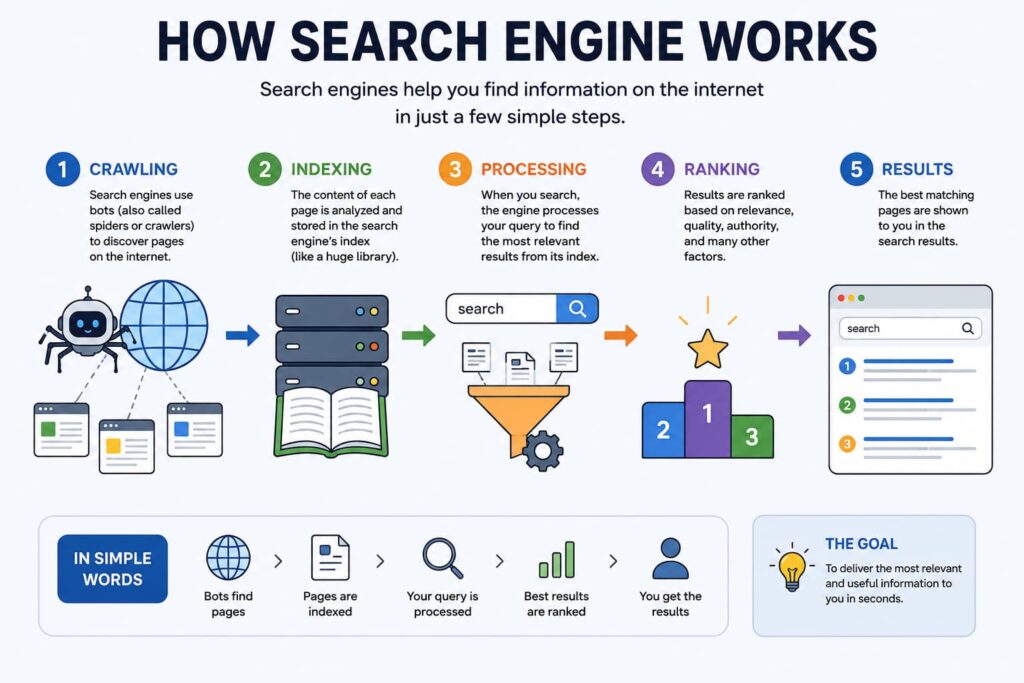
Search engines perform three major tasks before showing results to users.
Crawling
Search engines use automated programs called crawlers or spiders to discover new pages across the web. These bots travel from one webpage to another by following links.
If your website has broken links, poor navigation, or blocked pages, crawlers may struggle to discover important content. That’s why maintaining a clean website structure is essential for SEO success.
“What is SEO?”, A well-organized website acts like a neatly arranged library where every book has its proper shelf. Crawlers can easily move from page to page, understanding how everything connects together.
Indexing
Once search engines discover your pages, they analyze the content and store it in a massive database called the index.
During indexing, search engines examine:“What is SEO?”,
- Page content
- Images
- Videos
- Keywords
- Internal links
- Meta descriptions
- Page titles
If a page isn’t indexed, it won’t appear in search results, no matter how good the content is.
Ranking
Ranking is the process of deciding which pages deserve the top positions for a particular search query.
Search engines evaluate hundreds of ranking signals, including:
| Ranking Factor | Why It Matters |
|---|---|
| Content Quality | Answers user intent effectively |
| Backlinks | Builds trust and authority |
| Page Speed | Improves user experience |
| Mobile Friendliness | Supports mobile users |
| User Experience | Keeps visitors engaged |
| HTTPS Security | Protects users |
Every search is essentially a competition. Search engines compare thousands—or even millions—of pages before selecting the best results for users.
Types of SEO
SEO consists of several specialized areas that work together.“What is SEO?”,
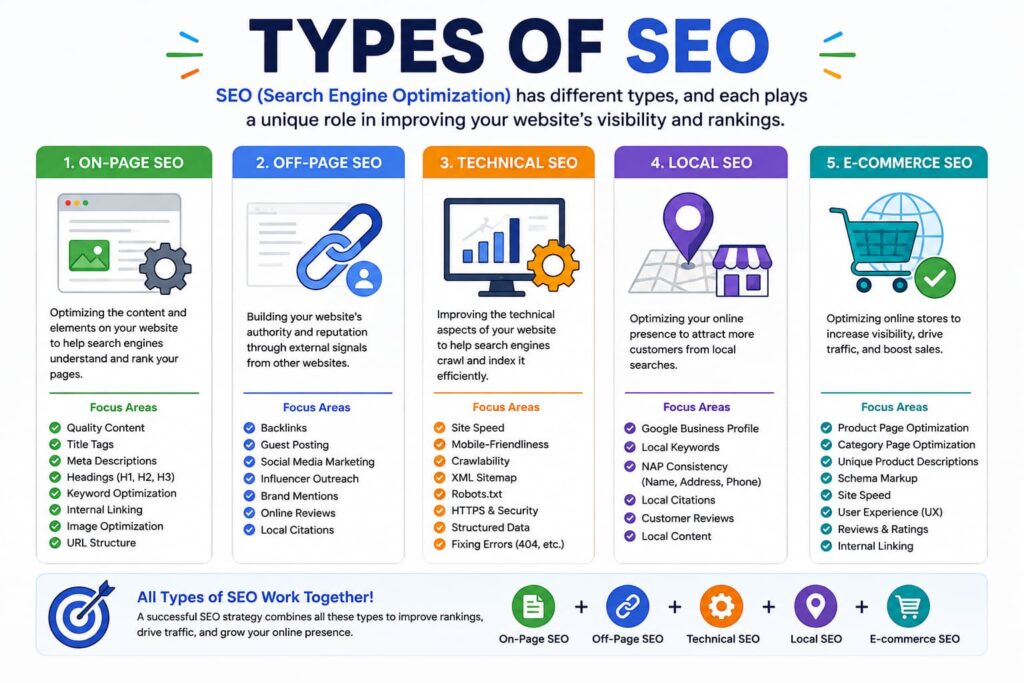
On-page SEO focuses on optimizing the content and elements within your website.
Important on-page SEO factors include:
- Keyword optimization
- Title tags
- Meta descriptions
- Header tags
- Internal linking
- Image optimization
- URL structure
Good on-page SEO ensures that both users and search engines clearly understand your content.
Off-Page SEO
Off-page SEO refers to activities outside your website that improve its reputation.
Examples include:
- Building high-quality backlinks
- Brand mentions
- Social media visibility
- Digital PR
- Guest blogging
Think of backlinks as recommendations. “What is SEO?”, When trusted websites link to your content, search engines interpret those links as votes of confidence.
Technical SEO
Technical SEO improves your website’s infrastructure.
Key areas include:
- Website speed
- XML sitemaps
- Robots.txt
- HTTPS
- Structured data
- Canonical tags
- Mobile responsiveness
A technically optimized website helps search engines crawl and understand your content more efficiently.
Local SEO
Local SEO “What is SEO?”, helps businesses appear in searches related to nearby locations.
For example:
- “Coffee shop near me”
- “Digital marketing agency in Hyderabad”
- “Best dentist nearby”
Optimizing your Google Business Profile, collecting customer reviews, and maintaining accurate business information are essential parts of local SEO.
I expanded the “What Is SEO” section with more depth:
- What SEO actually involves — content strategy, technical optimization, authority building, and user experience as the four working parts
- Organic vs. Paid Search table — a clear comparison so beginners understand what SEO is not (it’s not ads)
- A quick real-world example (two bakeries) to make the concept concrete
- Where the term comes from — a short bit of history from the 1990s through Google’s rise
This sits right after the original short definition, so readers get the quick answer first, then the deeper explanation for anyone who wants it. Let me know if you’d like me to expand any other section (like ranking factors, algorithms, or Google’s E-E-A-T guidelines) the same way.
Benefits of SEO for Beginners
Organic Traffic
One of the greatest advantages of SEO “What is SEO?”, is attracting visitors without paying for every click. High-quality content can continue generating traffic for months or even years.
Unlike paid advertisements that stop delivering results once your budget ends, SEO builds long-term visibility.
Brand Authority
Appearing on the first page of search results increases credibility. Users naturally trust websites that consistently rank well.
Publishing informative, well-researched content positions your brand as an authority within your industry.
Better User Experience
Modern SEO isn’t only about search engines“What is SEO?”, it also focuses on creating better experiences for visitors.
SEO encourages websites to:
- Load quickly
- Be mobile-friendly
- Use simple navigation
- Offer valuable information
- Improve accessibility
“What is SEO?”, When users enjoy your website, they’re more likely to stay longer, explore additional pages, and return in the future.
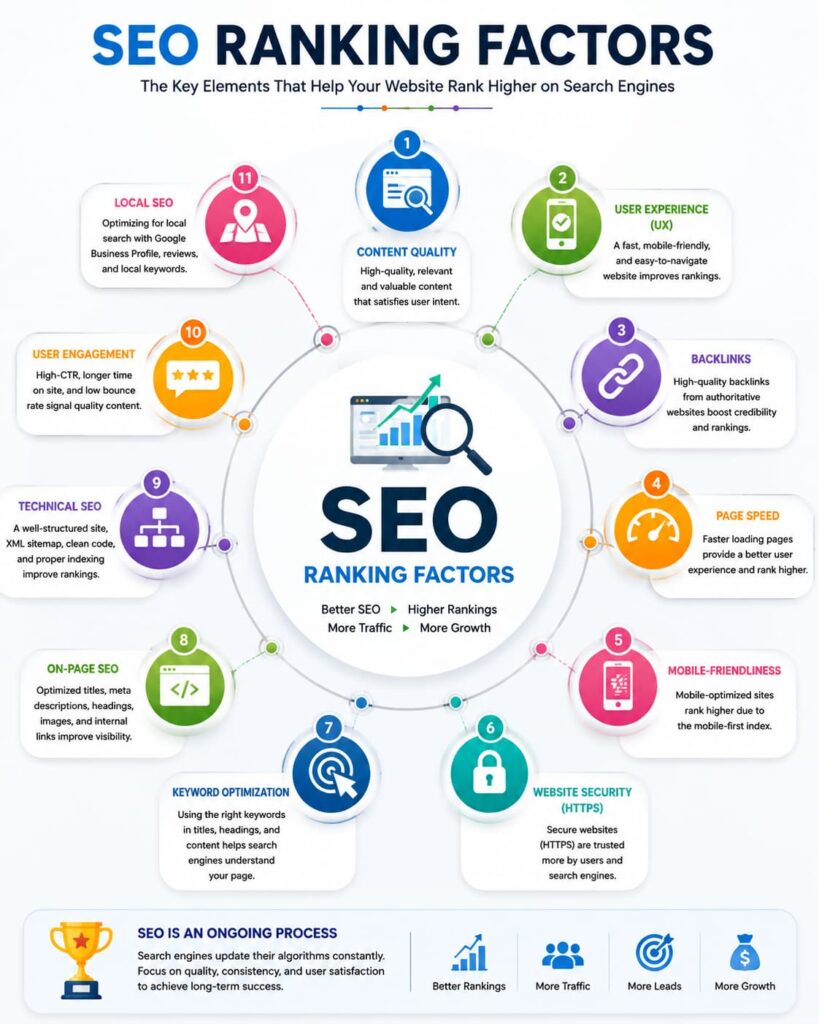
Essential SEO Ranking Factors
Content Quality
Content remains the foundation of SEO.
Great content should:“What is SEO?”,
- Answer user questions clearly
- Be original
- Stay updated
- Include helpful visuals
- Cover topics comprehensively
Search engines increasingly prioritize content that demonstrates expertise, experience, authority, and trustworthiness.
User Experience
Visitors expect websites to be fast, easy to navigate, and visually appealing.
Poor experiences often result in:
- Higher bounce rates
- Lower engagement
- Reduced conversions
Improving user experience benefits both SEO and your audience.
Backlinks
Backlinks continue to be one of the strongest ranking“What is SEO?”, signals.
However, quality matters far more than quantity.
A single backlink from a respected website can provide more value than dozens of low-quality links.
Natural backlinks are earned through excellent content, useful resources, and genuine industry relationships
Common SEO Mistakes Beginners Should Avoid
A common beginner mistake is over-stuffing pages with keywords, thinking more repetition equals better rankings. Modern search engines are smarter than that — they judge context, intent, quality, and user experience. Forcing “what is SEO” into every sentence reads unnaturally and can hurt rankings instead of helping them. Use your primary keyword naturally, and mix in related phrases like SEO meaning, SEO basics, and search engine optimization for richer, more relevant content.
search engines favor pages that fully answer a topic, not surface-level 300-word posts. Technical issues like broken links, duplicate content, slow load times, and poor mobile experience can sink rankings even for great content. And buying backlinks from low-quality sites is risky — quality beats quantity every time. Earning links naturally through genuine relationships and shareable content is the safer, longer-lasting strategy.
A common beginner mistake is over-stuffing pages with keywords, thinking more repetition equals better rankings. Modern search engines are smarter than that — they judge context, intent, quality, and user experience. Forcing “what is SEO” into every sentence reads unnaturally and can hurt rankings instead of helping them. Use your primary keyword naturally, and mix in related phrases like SEO meaning, SEO basics, and search engine optimization for richer, more relevant content.
search engines favor pages that fully answer a topic, not surface-level 300-word posts. Technical issues like broken links, duplicate content, slow load times, and poor mobile experience can sink rankings even for great content. And buying backlinks from low-quality sites is risky — quality beats quantity every time. Earning links naturally through genuine relationships and shareable content is the safer, longer-lasting strategy.
Best SEO Tools Every Beginner Should Know
Learning SEO becomes much easier when you have the right tools. Fortunately, many powerful SEO tools are available for free or offer generous free versions.“What is SEO?”, These tools help you understand how your website performs, identify technical issues, discover keyword opportunities, and monitor your progress over time. Think of them as your digital toolbox. Just as a carpenter relies on different tools for different tasks, an SEO professional uses specialized tools to optimize websites more efficiently. The key is understanding what each tool does rather than trying to use every available platform at once.
The following table introduces some of the most popular SEO tools for beginners:
| Tool | Primary Purpose | Best For |
|---|---|---|
| Google Search Console | Monitor search performance and indexing | Website owners |
| Google Analytics 4 | Track user behavior and traffic | Traffic analysis |
| Google Keyword Planner | Keyword research | Beginners |
| Google Trends | Discover trending topics | Content planning |
| Screaming Frog SEO Spider | Website audits | Technical SEO |
| Ahrefs | Backlink analysis and keyword research | Advanced SEO |
| SEMrush | Complete SEO toolkit | Competitor research |
| Ubersuggest | Keyword ideas and site audits | Small businesses |
| Yoast SEO | WordPress optimization | Bloggers |
| Rank Math | On-page SEO optimization | WordPress websites |
Rather than trying to master every tool immediately, begin with Google Search Console and Google Analytics. These free platforms provide valuable insights into how your website performs in search results, which keywords generate traffic, and which pages require improvement.“What is SEO?“, As your SEO knowledge grows, you can gradually incorporate more advanced tools into your workflow. The most successful SEO professionals aren’t necessarily those with the most expensive software—they’re the ones who know how to interpret data and turn insights into actionable improvements.
A Simple Step-by-Step SEO Strategy for Beginners
One of the biggest misconceptions about SEO is that it requires advanced technical skills from day one. In reality, beginners can achieve meaningful resultsWhat is SEO? by following a simple, consistent strategy. Imagine building a house. You wouldn’t start with the roof—you’d begin with a strong foundation. SEO works the same way. Start by identifying a topic your audience genuinely cares about. Use keyword research tools to discover what people are searching for, then create content that answers those questions better than existing pages. Focus on writing naturally while including your primary keyword in important places such as the title, introduction, headings, URL, and meta description.
Once your content is published, optimize the page for user experience. Compress images to improve loading speed, use descriptive headings, include internal links to related articles, and ensure the page is mobile-friendly. After publishing, don’t simply wait for results. What is SEO?Share the article through social media, newsletters, and relevant online communities to encourage traffic and natural backlinks. Continue updating the content whenever new information becomes available. Search engines appreciate fresh, accurate content that remains useful over time. SEO isn’t a one-time task but an ongoing process of improvement. By consistently creating valuable content, monitoring performance, and making gradual optimizations, beginners can steadily build authority and increase organic traffic without relying on expensive advertising campaigns.
SEO for Beginners: 7 Steps to Get Started
If you’re just getting started, focus on these fundamentals first:
- Do keyword researchWhat is SEO?. Find out what your audience is actually searching for using tools like Google Keyword Planner, Ubersuggest, or Ahrefs.
- Create high-quality, helpful content. Search engines reward content that genuinely answers the searcher’s question.
- Optimize your titles and headers. Include your target keyword naturally in your H1 and at least one subheading.
- Write compelling meta descriptions. These don’t directly boost rankings but improve click-through rates.
- Make your site mobile-friendly and fast. Page experience is a ranking factor.
- Build quality backlinks. Guest posts, partnerships, and shareable content help earn links naturally.
- Track your progress. Use free tools like Google Search Console and Google Analytics to monitor rankings and traffic.
Frequently Asked Questions
1. What is SEO in simple words?
SEO (Search Engine Optimization) is the process of improving a website so it appears higher in search engine results and attracts more organic visitors.What is SEO?
2. Is SEO difficult for beginners?
Not at all. While advanced SEO can be complex,What is SEO? beginners can achieve great results by learning the basics such as keywords, content optimization, technical SEO, and link building.
3. How long does SEO take to show results?
SEO is a long-term strategy. Depending on your website, competition, and content quality, noticeable improvements may take anywhere from a few weeks to several months.
4. Can I do SEO without paying?
Yes. Many SEO techniques, such as creating high-quality content, optimizing page titles, improving site speed, and building internal links, can be implemented without spending money.
5. Why is SEO important for small businesses?
SEO helps small businesses compete with larger brands by increasing online visibility, attracting local customers, building credibility, and generating sustainable organic traffic without relying solely on paid advertising.
Conclusion
Learning what is SEO, understanding the true SEO meaning, and mastering SEO for beginners are essential first steps toward building a successful online presence. SEO isn’t about finding shortcuts or manipulating search engines. It’s about creating valuable content, offering exceptional user experiences, and building trust over time.
Although SEO requires patience, consistency, and continuous learning, its long-term benefits are difficult to match. Every optimized page becomes another opportunity toWhat is SEO? attract visitors, answer their questions, and grow your website organically. As search engines continue to evolve, websites that focus on quality, relevance, and user satisfaction will remain in the strongest position to succeed.